In 2025 the Balearic government's posidonia patrol asked 10,062 boats to lift their anchors and move. Environmental agents wrote 48 formal reports. Those two numbers say more about anchoring in the islands than any brochure: you will rarely be fined, you may well be moved, and a move late on an August afternoon usually means the sand patches in the cove are already taken.
That matters most on a one-week charter out of Palma or Port de Pollença, where each night counts. The rules are simple and the buoys are cheap. The sand is there too, if you know how to look for it.
The rule, and what breaking it costs
The Govern's Decree 25/2018 of 27 July 2018 bans anchoring on Posidonia oceanica across the islands as a general rule. Inside a regulated buoy field, you take a buoy and never drop the anchor. The chain counts as much as the anchor: the Govern's own good-practice guide asks for more chain, and more distance from the meadow, as the boat and the wind get bigger.
The fines come from two older laws, the Balearic natural areas law of 2005 and the Spanish biodiversity law of 2007. As La Voz de Ibiza summed them up in August 2025, a minor offence costs 100 to 6,000 euros, a serious one up to 100,000 and a very serious one up to 450,000. The Balearic high court annulled the decree's own penalty rules in 2021 as too vague. The ban stands, and so do the fines under those laws.
In practice, enforcement is a conversation from a RIB. Twenty patrol boats work from 1 June to 10 October in 2026. In 2025 the service made 156,043 anchoring checks and found 6.4% of anchored boats on the meadow. Ibiza is the sore point, at 21%. Formentera was down to 2%.
Why the fuss? The islands hold about 650 km² of meadow, roughly half of Spain's, and CSIC researchers measured its rhizomes spreading about a centimetre a year. At that pace, a scar three metres across needs well over a century to close.
Check the bottom before you let go
Start the night before, on a laptop. The Govern's posidonia viewer maps the meadows and the outline of every buoy field. On the phone, the Govern points boaters to three apps: Posidonia Maps, Donia and Projecte Posidonia. Our list of boating apps worth installing for a first season covers the rest of the phone.
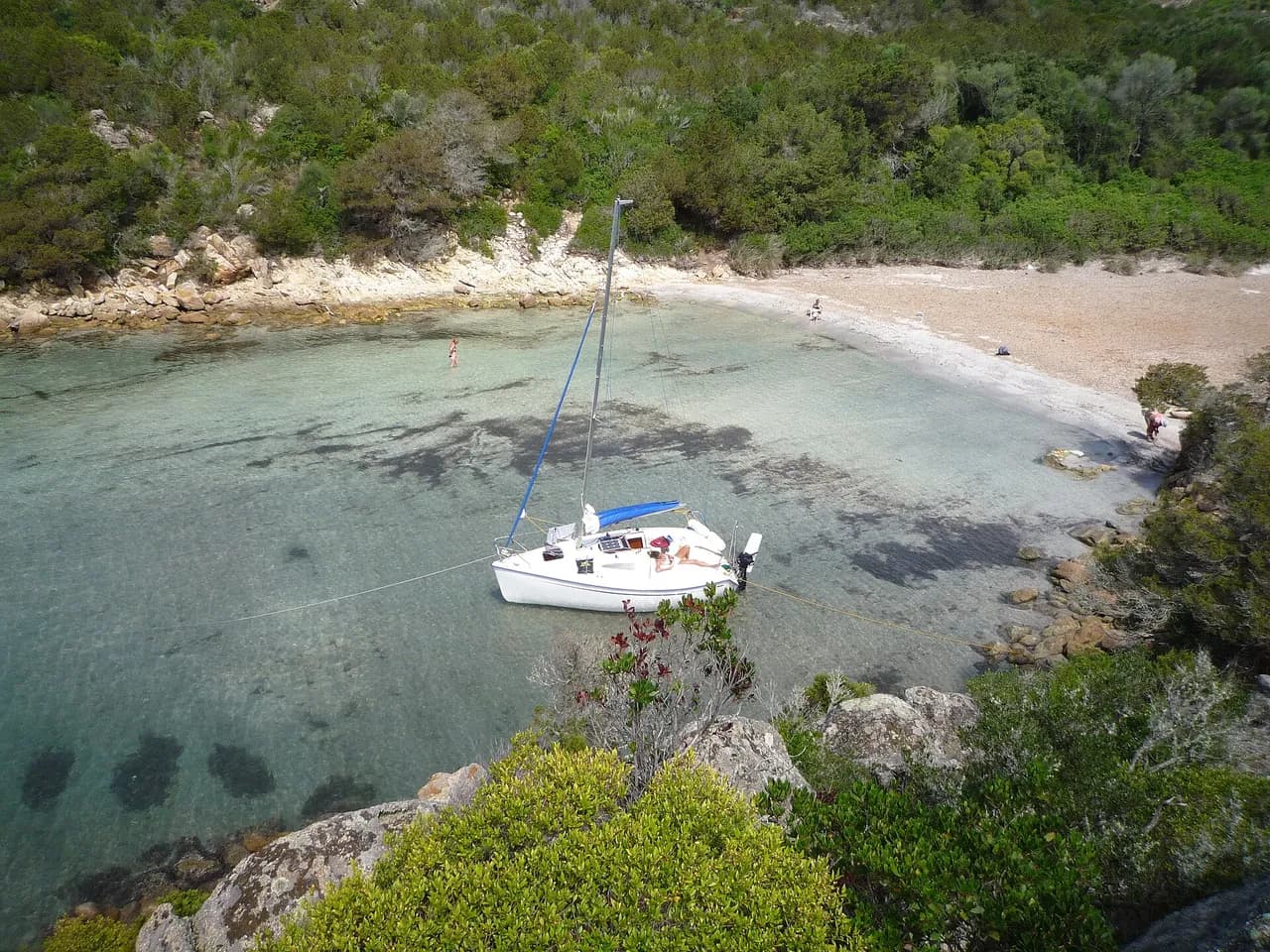
Then use your eyes. With the sun high, posidonia reads dark: olive brown close up, nearly black in deeper water. Sand reads pale turquoise. Most coves show a dark carpet with light patches cut into it, and your patch has to take the anchor, the chain and the swing of the boat. Low sun makes this hard. Polarised sunglasses help, and a mask over the side settles any doubt.
We would keep off the meadow even without the law. An anchor dropped on posidonia lands on long ribbon leaves over a dense mat of old rhizomes. It can feel set, then skate out when the breeze swings round in the afternoon. On sand, an anchor dug in properly with four to five times the depth in chain is the dull, reliable answer.
The catch is August: in the popular coves the sand is taken by late morning, so arrive early or plan on a buoy.
Buoy fields: where they are and how booking works
Ports IB, the regional port authority, takes the bookings for the regulated fields on its buoy reservation site. When we checked, it listed eight:
- Mallorca: Sant Elm, Cap Blanc to Cala Blava, and Formentor.
- Ibiza and Formentera: Badia de s'Alga at s'Espalmador, Es Caló de s'Oli, and Platja de Ses Salines.
- Menorca: the bay of Fornells, and Illa d'en Colom to Cala Tamarells.
The Govern announced three more for the 2026 season, with 25 buoys at Cala d'Hort and 24 at Porroig on Ibiza, and 21 off Illa de l'Aire on Menorca. Check that they take bookings before relying on them.
The price depends on the buoy, not on the boat. An overnight stay, from 18:30 to 18:00 the next day, costs 15.73 euros on an 8 m buoy, 36.30 on a 12 m buoy, 53.24 on a 15 m, 90.75 on a 20 m and 181.50 on a 25 m. A day visit on a 12 m buoy is 21.78.
The rules that catch people out, from Ports IB's booking conditions:
- You can book online until 21:00 on the day of arrival, but if you turn up after 19:30 without warning, the booking is cancelled and the fee is kept.
- Three nights in a row is the limit in one field, and you then need a four-day gap before booking that field again.
- Charter boats must upload a rental contract in the booker's name covering the dates; ask the base for one before you leave.
- The attendant works on VHF 77 from 12:00 to 20:00.
One honest warning: the conditions say the fields are for fair weather, not a refuge in a blow. Caló de s'Oli, for one, is open to the north and rolls in the ferry wash.
Cabrera: a permit first, and two nights in summer
You need an authorisation to navigate and anchor, requested online, and the overnight buoys are booked on the park's online booking system. The park caps anchoring at 50 boats a day. The limit is two nights in July and August and seven nights the rest of the year, and your buoy is yours from 18:00 on the first day to 17:00 on the last.
The fees are per day. From 1 May to 30 September a white buoy, for boats up to 12 m, costs 18.60 euros, and a yellow buoy, over 12 m and up to 15 m, costs 40.00. The jump at 12 m is steep, so check the length on your charter papers, not the number in the boat's name.
Where the hook actually holds
The pattern repeats: sand patches in 3 to 10 m inside a ring of posidonia, rock along the sides. Five places with sand, and the wind each one cannot take:
- Platja de Muro, Bay of Alcúdia (Mallorca). Sand in 5 to 6 m, good holding and plenty of room. Open to the north and east, yet a BoatMap reviewer held through 20 knots from the north in May 2025.
- Cala Varques (east Mallorca). Sand in 5 to 7 m with little weed, room for about ten boats overnight. Open to the east and south-east, so swell often works in at night, and the excursion boats throw wake by day.
- Cala Pregonda (north Menorca). Sand from 3 to 10 m that holds well, room for three to five boats. Open to the north and north-east, so leave as soon as a tramuntana appears in the forecast.
- Cala Macarella (south Menorca). Sand in 5 to 10 m between posidonia patches; wardens check that anchor and chain both lie on sand. Sheltered from the north, so a tramuntana bolt-hole, but a southerly swell makes it roll.
- Ses Illetes (Formentera). Sand patches in 3 to 7 m among posidonia and rock, good holding once you find them; deep keels do better a little further south. The wash is the price: ferries and fast motorboats keep it rolling until the evening.
Calm at ten, choppy by three
Mallorca's afternoon sea breeze, the embat, is not folklore. We pulled Meteostat's hourly records for Palma airport, at the head of the bay, for July and August 2024. At 10 in the morning the wind averaged 5.5 knots, most often from the east. At 3 in the afternoon it averaged 12.9 knots, from the south-west on 41 of 62 days, and blew 12 knots or more on three afternoons in four. It usually dies at dusk.
A cove open to the south-west is glassy at breakfast and a short, steep chop by the time the dinghy has to come back from the beach. Choose the lunch stop for the 3 pm wind, not the 10 am one.
Menorca's problem is the tramuntana. At Menorca airport, over July and August from 2022 to 2025, a northerly of 15 knots or more blew for at least an hour on 11 to 20 days each summer, and 20 knots or more on 4 to 8 days. That is not a winter gale, but on the north coast it turns a cove like Pregonda into a lee shore with a swell, while the south coast calas are usually sheltered. When a tramuntana is forecast, move south a day early.
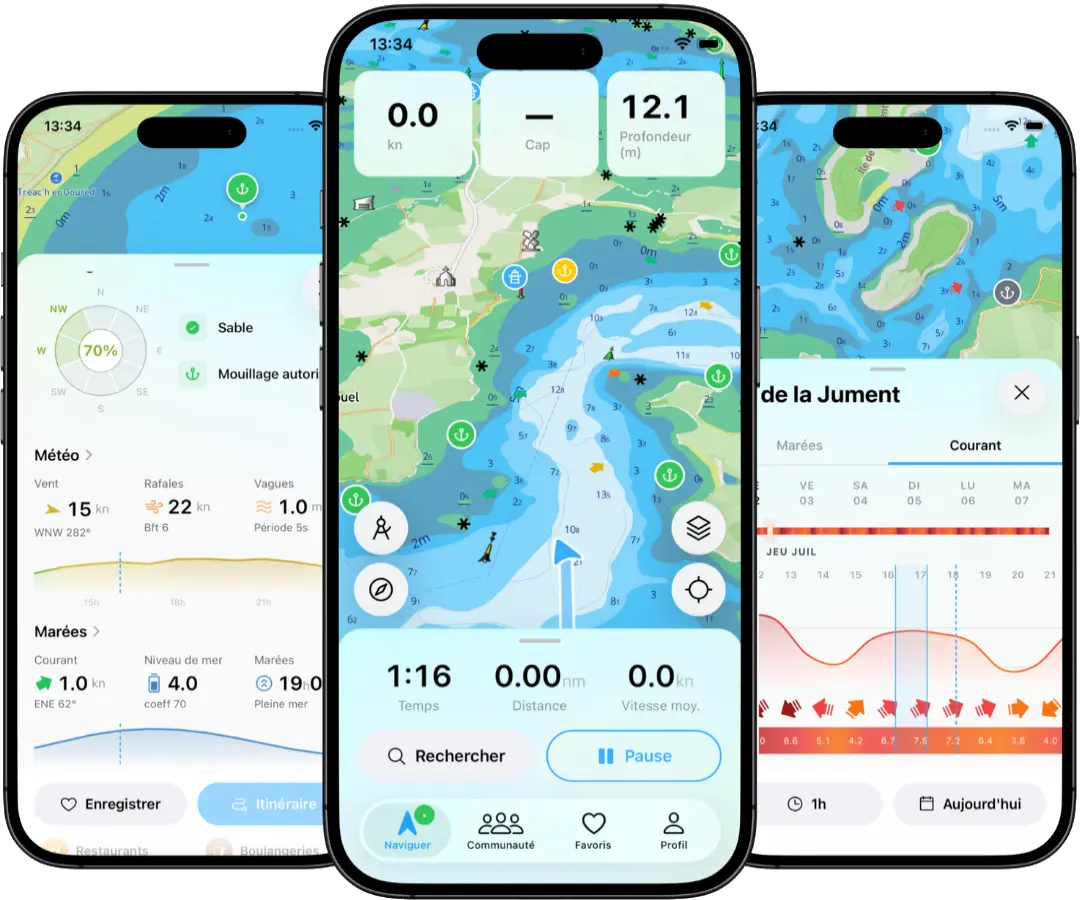
This is where BoatMap earns its place on the phone: each anchorage carries a protection score worked out against the wind forecast for the night ahead, and the reviews are often where someone has written down which corner has the sand. It also has its own chart layer for Spain.
What a night costs
Anchoring on sand is free.
Mahón is easy to price, because Club Marítimo de Mahón publishes its tariff: the maximum visitor rate approved by the port authority, labelled 2026, is 1.75 euros per square metre per day in July and August for boats of 8 to 15 m, counted on length times beam, before 21% VAT. A 12 m monohull about 4 m wide pays for 48 m²: 84 euros, about 102 with VAT. A 12 m catamaran about 7 m wide pays for 84 m², about 178 euros with VAT. On 1 September the low-season rate of 0.50 euros applies, and the monohull night drops to about 29 euros with VAT.
Palma is harder to price: its big clubs did not publish visitor rates on their websites when we checked. In June 2026 a Spanish berth-booking site put Palma's top marinas at 70 to 120 euros a night for a 10 m boat in peak season. For comparison, see what a berth really costs on the Cote d'Azur.
The other option is the public berths Ports IB runs itself, bookable on the same site as the buoys: boats up to 15 m in Pollença, Sóller, Andratx and five other ports, up to 12 m in Ciutadella, Fornells and two more, for five days at most per port. Expect to berth Mediterranean style, stern or bows to the quay, so if the crew has never done it, read how to pick up a lazy line without drama before the first one.
For a 12 m monohull in August, seven nights on the Mahón tariff come to about 711 euros, on Ports IB buoys about 254, and on sand nothing. Our pick is two marina nights for water, laundry and showers, and the rest at anchor or on a buoy.
When something breaks between coves
An anchor fouls on rock or old ground tackle: a BoatMap reviewer had a chain jam among rocks in 16 m of weed at Cala Figuera, on the Formentor peninsula, in August 2024. Before you lean on the windlass, motor slowly round the anchor on a short chain, or pull from the opposite direction to the one it was set in; in rocky coves, rig a trip line from the start. A windlass that stops dead is often the breaker, the solenoid or a corroded connection: know where they are, and where the manual handle lives. A dead dinghy outboard is usually fuel, kill cord or plug, in that order.
On a charter boat, call the base first. On your own boat, or with the base three islands away, you need a local diver or mechanic quickly. Nautify is a free directory that connects boat owners with nautical professionals in Spain, and the Balearics are where it is strongest: of the 441 services listed when we checked, 123 were in Mallorca, 37 in Ibiza and 34 in Menorca, covering repair and maintenance, diving, cleaning, skippers, charter and moorings. You search by service and by port, compare providers on their photos and on reviews from other owners, and one quote request reaches up to three of them; the site runs in five languages, English included.
Before you leave the base
- Install one of the posidonia apps, and open the official viewer once on a laptop.
- Book s'Espalmador or Formentor buoys for the nights that matter, with the charter contract to hand.
- Book Cabrera early, and check your boat's length against the 12 m line.