On paper, the 3 m air-floor inflatable in the July 2026 tender test by Motor Boat & Yachting (MBY) weighed 32 kg. On the testers' scales, with its seat, oars and bag, it came out nearer 40. Add a 24 kg outboard, a fuel can and lifejackets, and the first lesson of a small inflatable has nothing to do with water: it is the walk from the car park to the slipway.
We like these boats anyway. A soft inflatable, a SIB in Britain, rolls into a car boot and needs no mooring. Most first-season regrets come from four choices made at the kitchen table: the floor, the size, the engine and the place you launch. The boats are the same on both sides of the Atlantic; the paperwork is not, so there is a section for the UK and one for the US.
Four floors, one name
Three floors are sold as SIBs, and a fourth boat gets mixed up with them.
- Slatted floor: wooden or aluminium slats in a fabric floor. Light and cheap, and you feel every slat through your knees.
- Air deck: a high-pressure drop-stitch floor that rolls up with the boat and, once hard, takes standing on. Most car-boot buyers end up here.
- Plywood or aluminium floorboards: sections over an inflatable keel. Stiffest in a chop, slowest to assemble on a beach.
- Small RIB: a rigid hull with tubes, better in waves, but it means a trailer.
How many people a boat really takes
Every boat carries a builder's plate with its maximum people, load and engine power, and the plate wins over the photo on the box. Our working numbers, with gear and a bit of chop:
- 2.3 m: one adult with fishing gear, or two adults for a short, calm hop to a mooring
- 2.7 m: two adults and their gear, or two adults and a small child
- 3.0 m: two adults fishing all day, or a family of four on a lake
- 3.6 m: three or four adults, and the first size we would take along an open coast
Two adults and a dog in a 2.3 m tender is legal on most plates and unpleasant in practice: knees touching, the dog on the fuel line, and the first wake from a passing RIB over the bow. The MBY testers got six adults into their 3 m boat, rated for four adults and a child. They were sitting still, on flat water, for a photo.
Pressure, and why the foot pump goes back
Tubes run at about 0.25 bar, a tenth of a car tyre: Zodiac's manual gives 240 millibars (3.5 psi). Temperature moves that by about 4 millibars per degree: a boat pumped up on a cool morning and left on a hot beach can double its pressure. An air deck runs much harder, at the pressure printed by its valve, and a bellows foot pump never quite gets it there. A soft floor flexes, the boat hogs in the middle and struggles to plane. Budget for a 12 V pump with a pressure cut-off and keep the foot pump as a spare.
The outboard: 2.5, 6 or 9.9 hp
Until it planes, a 3 m inflatable tops out at around 4 to 5 knots. In MBY's test, that 3 m boat made 4.7 knots with a 1.6 kW electric motor, about 2 hp, and needed a bigger engine to plane.
A 2.5 hp four-stroke is the one-hand engine: Suzuki lists its DF2.5 at 13.5 kg dry. Enough for a tender, a lake or a short run to a mooring.
The 4 to 6 hp class is where we would point most first owners. Suzuki's DF4A, DF5A and DF6A share one body and weigh 24 kg dry with the short shaft. The extra power buys push against a tide or a headwind; do not count on it to plane a 3 m boat with two adults and gear. Honda says the 1.5 litre built-in tank of its BF5 lasts more than 40 minutes at full throttle, so allow about 2 litres an hour flat out and carry a separate tank.
That 24 kg is a dry weight. Carried at arm's length down a slipway at low water, over weed, it is a two-person job for most of us.
A 9.9 hp is usually what it takes to plane a 3 m to 3.6 m boat with two adults, if the floor is hard and the plate allows it. Suzuki's DF9.9A weighs 39 kg dry. The odd number is no accident: several American rules start at 10 hp, as the paperwork section shows.
Electric changes the arithmetic. ePropulsion's Spirit 1.0 Evo, a 1 kW motor sold as a 3 hp equivalent, weighs 10.6 kg plus 8.7 kg for its 1,276 Wh battery: two light lifts. The maker quotes 1 hour 15 minutes at full throttle, 10 km/h with one person aboard, and far longer at walking pace.
Whatever drives it, wear the kill cord. "The kill cord should be attached around your leg," says the RYA. In the US it has been federal law since April 2021: on a boat under 26 feet built from January 2020 with 3 hp or more, the lanyard must be attached whenever the boat is on the plane or above displacement speed, idling and docking excepted.
Paperwork in the UK
At sea, the RYA says there is no legal requirement in the UK to hold a licence to skipper a private boat. Inland, you pay for the water.
On canals and most rivers run by the Canal & River Trust, a powered boat needs a licence, and the Trust first asks for a Boat Safety Scheme certificate or exemption. Its online calculator gave us, for a 3.0 x 1.5 m boat from May 2026, 768.05 pounds for a year, 384.02 pounds with the half-price rate for a portable powered boat (small engine, launched by hand) and 41 pounds for a week. On the Thames, the Environment Agency's 2026 charges work out at 136.55 pounds a year for a small powered boat, or 15.70 pounds for a visitor day. The Broads have their own toll.
A handheld VHF needs a Ship Portable Radio Licence from Ofcom, free online (20 pounds by post), and an operator's certificate, the SRC, from an RYA course, both explained on the RYA's licensing page.
Paperwork in the US
The US starts where the UK stops: with the engine. Federal rules say that any vessel with propulsion machinery of any type must be numbered by the state where it is mostly used, so a 3 m inflatable with a 2.5 hp outboard gets registered, carries its numbers on the tubes and is renewed like a car. The one exemption is a tender of under 10 hp that only runs between a numbered mother ship and the shore; it then shows the ship's number with a 1 after it.
Who may drive it is a state matter. Most states ask operators born after a cut-off date to carry a boater education card above a certain engine size. Florida's line is typical: anyone born on or after 1 January 1988 needs the card to run a motor of 10 hp or more, which is why so many small boats wear a 9.9. The Coast Guard's engine cut-off switch page explains which boats the lanyard law covers; your state's boating agency has the rest.
The federal minimum kit for a boat under 16 feet is short: a wearable life jacket for every person aboard, which children under 13 wear under way where the state has not written its own rule; a whistle or horn; and on coastal waters and the Great Lakes, night distress signals such as three hand-held flares if you are out between sunset and sunrise. An open outboard boat with a portable tank and no closed compartment is exempt from carrying a fire extinguisher, though several states add one, and you need navigation lights to run after dark.
Safety for a boat this small
Lifejackets first, and worn: the RNLI says someone in the sea wearing one is four times more likely to survive. Then a way of calling for help that works when wet, a check of the forecast and tide times, and someone ashore who knows your return time.
Two winds catch inflatables. On a sunny day a sea breeze builds onshore as the land warms, and can turn a flat bay into a short chop by the afternoon. An offshore wind is the opposite trap: the water near the beach looks flat, but a light boat with a stalled engine blows away from land faster than most people can row an inflatable. Stay close enough to shelter that a dead engine is an inconvenience.
Launching: slipways, ramps, tides and the car park
Slipways and ramps usually publish fees and hours. Rye Harbour, run by the Environment Agency, charges 14 pounds a day for 2026-27, dues and VAT included; in the US a public ramp can be free, a day ticket at the kiosk or a yearly state pass. Check where the car and trailer go and whether the slip ends in soft sand or mud: many that are fine at half tide end in mud at low water, so read the tide table for that harbour, not the nearest city.
Do everything in the car park: inflate, fit the engine and launch wheels, fuel up, stow the kit, clip on the kill cord, then launch in one go. Nobody minds a slow launch; everybody minds a ramp blocked for twenty minutes by someone pumping up a floor.
A rolled-up boat goes in the boot. A 3 m air deck with its engine fitted is easier kept inflated on a small trailer, with a trailer board carrying lights and your number plate. A UK car licence passed from 1 January 1997 covers trailers up to 3,500 kg, and no US state asks for a special driving licence to tow one this small.
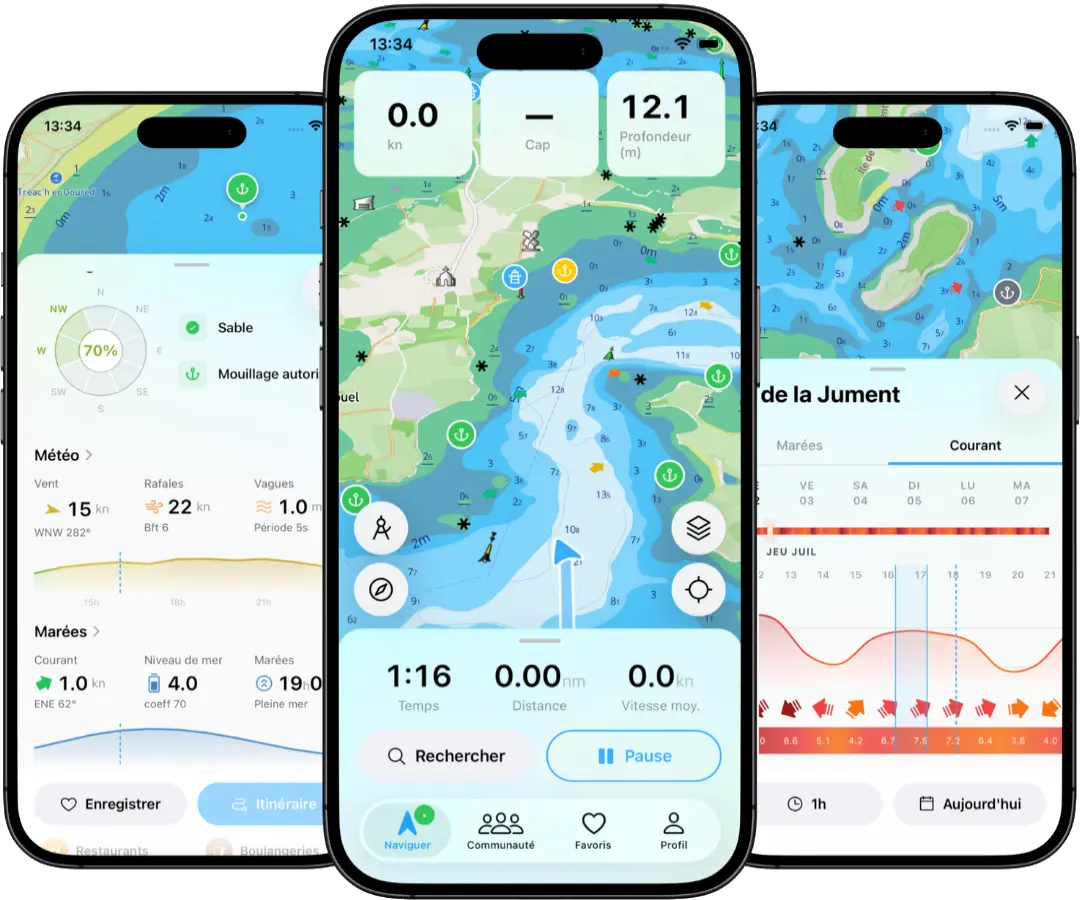
In the US, BoatMap puts boat ramps on the same map as marinas and anchorages, with reviews and photos from other boaters, such as whether the ramp dries at low water; the coverage is laid out region by region, from Maine to Hawaii. Tap a ramp for the forecast at that spot, or an anchorage for a protection score that follows the wind. Around the UK it lists about 1,800 harbours, moorings and anchorages, fewer than in the US, so there, check the harbour's own page as well; for other apps, see our first-season apps guide.
What a first season costs
The 3 m boat from MBY's test is the Air V 300 from Boatworld, a retailer in Chesterfield, in Derbyshire, well inland. The company dates from 1969 and a mail-order catalogue; today it sells online, within the UK only, mostly its own-brand inflatables (Lite, Air Deck, Air V, Carbon Pro) alongside Tohatsu, Honda and Orca petrol outboards and ePropulsion and Torqeedo electric ones, with a three-year warranty on its boats and outboards. The Chesterfield showroom is open Monday to Friday from 9am to 4pm and on seven Saturdays a year, 24 October being the last of 2026, and a few partner showrooms, such as Nestaway Boats in Christchurch, carry part of the range. For a first buyer, the useful parts of the site are the product pages, which give the hull weight, the packed weight and the box size separately (37.5 kg packed for the Air V 300, with seats, oars, stirrup pump and bag), a 2026 buying guide that sorts the range by use (couples, tenders, solo, families, fishing) and a short guide to fitting an outboard. The blog also reprints the magazine tests of its own boats; read those at the source. For American readers the site is reference material rather than a shop.
With a 6 hp four-stroke, at Boatworld's prices at the time of writing:
- boat: 950 pounds, with seats, oars, stirrup pump and bag
- outboard: 1,116 pounds for a Tohatsu 6 hp short shaft
- 12 V electric pump: 62 to 100 pounds
- two automatic lifejackets: 130 to 180 pounds
- 12 litre fuel tank with line: 60 to 70 pounds
- grapnel anchor kit with chain and line: 25 to 60 pounds
That is roughly 2,350 to 2,500 pounds before a trailer, a VHF or a licence. In the US the engine is the easy line to price: Defender, the Connecticut chandlery, lists the 2026 Tohatsu 6 hp tiller at about 1,570 dollars.
The engine is the line to think hardest about. It decides the paperwork, the weight you carry down the slipway and how far you can go, and it will not fold into the boot.