
Summary
A helm dashboard is four things on one panel: engine data, navigation, boat data (depth, speed, wind) and switching. Most of that equipment has talked NMEA 2000 since the 2010s, so the backbone is the first thing to plan, not the last. At US retail prices, budget 1,000 to 1,600 dollars for a 9-inch plotter, 90 to 130 for the network kit, 420 to 710 per instrument display and 108 to 150 dollars an hour if a yard does the wiring. The rules are written down in ABYC E-11 in the United States and ISO 13297 in Europe, both paid documents.
What goes on the panel
Start from the four families and decide which you actually need:
- Engine: tachometer, fuel, voltage, trim, temperature. Analogue gauges from the 2000s still work; newer engines send the same data down one cable to a screen.
- Navigation: a chartplotter or multifunction display, 7 to 12 inches on boats under 12 m.
- Boat data: depth, speed through the water, wind, on a dedicated instrument or as a page on the plotter.
- Switching: lights, pumps, horn, electronics, each on its own breaker or fuse.
On a motor boat, depth and engine data are what you look at every minute. On a sailing boat it is wind and depth, with the autopilot control within reach of the helm: a small-boat Biscay crossing is steered by the pilot far more than by hand. Put what you look at most at eye level and the rest at the edges.
Layout before cutting
Sit at the helm, in the position you steer from, and tape paper cut-outs of the displays on the panel. Four things to check before the hole saw comes out:
- Reach: a touch screen you cannot reach with a bent elbow ends up driven by its buttons, or ignored.
- Sun: a screen facing the afternoon sun should be rated 1,000 nits or more. The B&G Vulcan 9 is rated at 1,200 nits, the Raymarine Axiom 2 Pro 9 at 1,300. Under a hard top, less will do.
- Depth behind the panel: a 9-inch plotter such as the Garmin GPSMAP 923xsv is 233 x 162 mm on the face and 76 mm deep, plus the bend radius of its cables. Measure what is already behind the panel, steering cables and hoses included.
- Compass safe distance: every display lists one, 300 mm for the B&G Triton2. A steering compass inside that distance reads wrong.
Round gauges come in two standard sizes: 52 mm (2 1/16 in) for fuel, voltmeter and trim, 85 mm (3 3/8 in) for the tachometer, which needs about 55 mm clear behind the panel. Both hole saws are stock items at any tool shop. Electronic instrument displays (Garmin GMI 20, Raymarine i70s, B&G Triton2) have a square face of 110 to 118 mm by 115 mm with a round cut-out behind it, 90 mm on the GMI 20: use the paper template in the box, the diameter varies by brand.
Three ways to mount: flush in the panel (clean, needs the depth), on the bracket supplied (quick, but it catches ropes and sits in the sun), or in a pod. A Scanstrut ScanPod deck pod for a 10 to 12-inch display, the model that screws to a flat surface rather than clamping on a pedestal guard, costs 500 to 710 dollars uncut and spares a dash that is curved or too thin to cut.
The panel itself
An original dashboard in moulded plastic or thin GRP rarely takes a 9-inch cut-out next to the old gauges. The usual fix is a new panel: 3 mm aluminium plate, powder-coated or anodised, or 6 to 12 mm black HDPE sheet, cut to the old outline and drilled for the new layout. Holes you no longer need are blanked with a plate behind the panel.
Seal the fixings with butyl tape or a gasket on HDPE, since nothing bonds to it, and with butyl or a polyurethane sealant such as Sikaflex-291i on aluminium and GRP. Keep silicone off gelcoat: nothing sticks to it afterwards.
One backbone: NMEA 2000
Most plotters, instruments, autopilots and AIS units sold since the 2010s talk NMEA 2000 and share one cable. A wired masthead wind sensor joins through its own interface box, and many VHF radios still speak the older NMEA 0183. A starter kit (Garmin's sells for 90 to 130 dollars) contains a 6 m backbone, two tees, two terminators, a 2 m drop cable and a 2 m power cable, enough for a first installation.
The rules of the backbone, from Garmin's installation documentation and Actisense's network design guide:
- a terminator at each end of the backbone, one male and one female, never in the middle
- 6 m maximum for any drop cable from the backbone to a device, and 78 m for all drops added together
- 100 m maximum backbone with light (micro) cable, 250 m with mid or heavy cable
- 50 devices maximum
- 12 V power through a dedicated tee on its own switched circuit, fused at 3 A, the fuse supplied with Garmin's power cable
Engine data is the usual sticking point. Engines with a digital bus (Yamaha, Mercury SmartCraft, Volvo Penta EVC and most J1939 diesels) connect through the manufacturer's own interface or a third-party gateway such as the Yacht Devices YDEG-04 (249 dollars; Volvo Penta, SmartCraft, Suzuki and J1939 engines, not Yamaha). An older engine with analogue senders needs a converter such as the Actisense EMU-1 (560 to 690 dollars, plus an Actisense NGT-1 or NGX-1 USB gateway to configure it), which turns the tachometer, temperature and oil pressure signals into NMEA 2000 messages. For one old outboard, keeping the analogue gauges is often the better deal.
Wiring and fuses
ABYC E-11 in the United States and ISO 13297:2020 in Europe, which replaced ISO 10133 for DC installations, say what a dashboard circuit must look like:
- Stranded copper conductor, 16 AWG minimum (1.5 mm² is the nearest metric size); 18 AWG is allowed only inside a sheathed bundle, and no more than 760 mm outside it.
- Every positive conductor fused within 178 mm (7 in) of its source. The distance stretches to 1.02 m if the wire runs in a sheath or conduit, and to 1.83 m only when it leaves a battery terminal and is sheathed its whole length, as Blue Sea Systems summarises E-11.
- Voltage drop of 3 % maximum for electronics, navigation lights and the panel feed, 10 % for cabin lights and other non-critical circuits, according to ABYC's guidance on voltage drop. Length counts both ways, positive and negative.
- Crimped heat-shrink terminals, no twist-on connectors; solder may not be the only thing holding a joint.
- Label every wire at both ends.
A fuse block with a negative bus and a clear cover (Blue Sea ST Blade 12-circuit, 60 to 74 dollars) behind the dash replaces the usual nest of in-line fuses. The displays draw little: a 9-inch plotter takes about 1.3 A typical and 2 to 3 A peak at 12 V, Garmin's figures for the 923xsv. The VHF on transmit and the autopilot drive are the loads that size the feed from the battery.
Water, front and back
Marine displays carry an IP rating: IPX6 means they take a powerful jet from any direction, IPX7 means 30 minutes under 1 m of water. The Vulcan 9 and the Axiom 2 Pro 9 are rated IPX6 and IPX7, the GPSMAP 923xsv IPX7. The rating covers the sealed unit with its plugs mated. The weak points are the open connectors, the boat's own power and network plugs and condensation behind the panel: run each cable with a drip loop below its connector, bring it through the panel in a cable gland and leave the sun covers on at the mooring.
A phone or tablet as the dashboard
A phone does part of this job well. An iPhone 17 is rated 1,000 nits in normal use with peaks of 3,000 nits outdoors, brighter than most plotters on paper, but the peak is short-lived and the panel dims as the phone heats up. An iPad Air is a different story at 500 to 600 nits. Apple rates both for 0 to 35 °C ambient, as its support page on overheating explains: in the sun on a black dashboard the screen dims, then the phone announces it needs to cool down. Wet fingers on a capacitive screen and a battery drained by the GPS finish the argument.
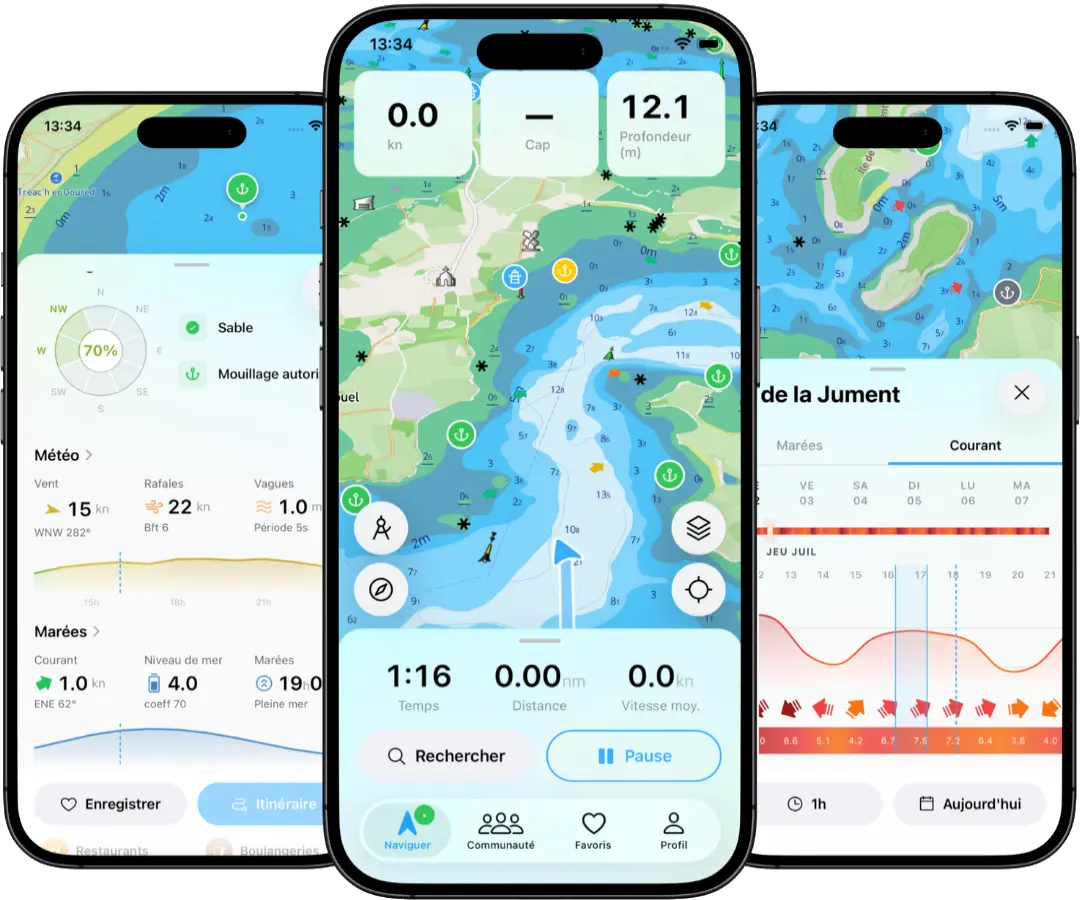
A workable layout is the plotter as the fixed screen at the helm and the phone on its own mount, charging cable plugged in, as the second screen for what the plotter does not have: the ports, anchorages and boat ramps around you with reviews from other boaters, the weather on each spot, the tides on French coasts and a protection score for the anchorage you are heading to. That is what BoatMap does, on iPhone and Android, with the charts downloaded for offline use on the Explorer plan. There is no iPad app; on a tablet, the web version runs in the browser.
When you are not aboard
A dashboard tells you what is happening while you look at it. Most boats spend most of the year with nobody looking, often plugged into shore power on an annual berth, the kind priced per metre on the Riviera. The failures of those months are quiet: a pedestal breaker trips, the charger stops, the bilge pump runs the battery flat, rain finds the one hatch left ajar.
A monitor such as Sentinel is the dashboard for those months. The unit wires to the battery on its own fuse, with a sensor on the shore-power circuit, a high-water sensor in the bilge and a contact on the companionway hatch, and the alerts reach your phone: shore power disconnected, voltage under the threshold you set, water rising, hatch opened, boat drifting outside its geofence. The entry bundle is listed at 699 euros including VAT on the manufacturer's site, first year of service included, then 150 euros a year. Fit it while the panel is open and the negative bus is in front of you; it is the cheapest moment to run its wires.
Cost and time
If you do the wiring yourself, the bill is the parts: plotter, network kit, one or two instrument displays, fuse block, wire and terminals, a new panel or a pod. For an American owner doing that work, Sailboats USA, a free site built by a sailor for owners who do their own work, is a good first stop: wiring and engine guides, sources for used and OEM parts, and marinas, surveyors and yacht clubs listed for all 50 states. If a yard does it, the rate sheets of three US yards (Rockport Marine, Snead Island Boat Works, Schooner Creek Boat Works) give 108 to 150 dollars an hour for electrical work, and a full dashboard with an engine gateway is a two-day job. A plotter swap in an existing cut-out is half a day. Ask for the hourly rate and the estimate in writing, and for the wiring diagram at the end.
Worked example
Outboard cruiser of 7.5 m, 2012, original dash with an 85 mm tachometer and three 52 mm gauges, no electronics. The gauges stay. Added: a Garmin GPSMAP 923xsv with its sonar built in (1,600 dollars, transducer sold separately), a Garmin NMEA 2000 starter kit (105), a Garmin GMI 20 instrument on the companion's side (500) and a Blue Sea 12-circuit fuse block (61). The 9-inch cut-out went into a 3 mm aluminium plate replacing the plastic dash. Parts: about 2,300 dollars excluding the transducer and wire, and two or three weekends of work, plus a haul-out if the transducer goes through the hull. The same job by a yard at 120 dollars an hour: 12 hours, 1,440 dollars of labour on top.
The dashboard shows the boat. The phone beside it, with BoatMap, shows the coast.