The pedal fishing kayak most people picture, a Hobie Mirage Outback, is 12 feet 9 inches long and weighs 85 lb as a bare hull. Rigged with its drive, seat and rod holders it is 103 lb, before the cooler, the tackle crate and the battery for the fish finder. The hardest part of kayak fishing is not the fish. It is the 80 yards between the tailgate and the water, at 5:40 in the morning, with nobody to take the other end.
We say this to every new kayak angler who asks us which app to download: the kayak is a boat. It launches like a boat, it is registered like a boat in a growing list of states, and it shares the ramp with people towing 24-foot bay boats who are not thrilled to find a kayak being rigged in the middle of the lane. What follows is one launch morning, in order, from the driveway to the first cast, with the rules that apply at each step.
In the driveway: the weight you are about to carry
A kayak's weight is quoted two ways and the honest one is the second. The hull weight is what the brochure prints; the rigged weight is what you lift. On a one-piece pedal boat the gap is 15 to 20 lb, and the rigged figure is what decides whether you need a roof rack, a trailer or a second person.
Three ways around it. A cart with two wheels, strapped under the hull, turns the carry into a walk, as long as the put-in has a path and not stairs. A pickup bed with a bed extender takes anything up to 13 feet. And a growing number of hulls now come apart.
Modular kayaks are the newer answer, and the one we would point an apartment angler to. Reel Yaks, an online brand based in Casper, Wyoming, sells pedal and paddle fishing kayaks that split into two or three sections, clip together without tools and ride inside a hatchback or a pickup bed. Its 9.5-foot Raptor, with a fin drive and a 380 lb capacity, breaks into two 35 lb halves; at the time of writing it was listed at 1,098 dollars, marked down from 1,299, and the 13.8-foot tandems, in three pieces, at about 2,700. Shipping is free within the US and Canada, returns run 30 days and the warranty two years. Two things to read before ordering: the delivery estimate changes with the model, from one to two weeks up to eight to eleven, so buy before the season rather than the week of, and the joints are the part to rinse and inspect after every salt launch, the way you would a trailer's wheel bearings. The blog has a usable list of kayak fishing apps, and it recommends a hiking app, AllTrails, for finding carry-in launches, which tells you how thin the information on put-ins still is.
Whatever you carry, do the arithmetic at home. Two 35 lb halves are two trips; one 103 lb hull on a cart is one trip and a flat path. Neither is a bad answer. Finding out at the water is.
At the access: ramp or carry-in
A concrete ramp exists for trailers. A kayak can use one, and on a lake with no other access it will, but the ramp is the worst place to rig a kayak and the best place to make enemies. Our rule is the same one we give first-time inflatable boat owners: everything happens in the parking lot. Drive in, seat in, rods in their holders, fish finder wired, life jacket on, then carry the boat to the water's edge beside the ramp, not down the middle of it, and push off. Nobody minds a kayak that takes 40 seconds on the ramp. Everybody minds the one that takes 15 minutes.
The better launch for a kayak is usually not the ramp at all. Carry-in put-ins, a sand bank under a bridge, a county park with a kayak dock, the end of a dirt road at a tidal creek, mostly cost nothing, have no queue and put you in water a bay boat cannot reach. The trade is information: the ramp is on every map and the put-in is on none, which is why that hiking app ends up on an angler's phone.
Fees exist, and they are mostly for the car, not the boat. Washington's Discover Pass, 45 dollars a year since October 2025, is what lets you park at a state park launch. Pennsylvania goes further and asks for the boat itself: any unpowered kayak using a Fish and Boat Commission access or a state park launch needs either a registration or a launch permit, and 22 dollars buys two years of either. Most county and city ramps charge the trailer and wave the car-top boat through for free; check the sign at the gate, or ask the one person who always knows, the attendant selling bait.
The creek: tide, current and the mud under it
On a lake the water is where you left it. On the coast it moves, and a kayak angler feels it more than anyone, because the boat has no engine to push back with.
Take Charleston, South Carolina, where NOAA's harbor station gives a mean tidal range of 5.22 feet. A tidal creek that floats a kayak at half tide is a mud flat two hours later, and the mud is not the kind you walk on. The launch that looked perfect on the satellite picture at high water is 100 yards of ooze at low. Read the tide table for the station nearest the creek, not the one for the city, and launch on the second half of the flood if you can: the water is rising under you while you rig, and the ebb will carry you home.
The ebb is also the trap. Pedal out with the tide behind you for two hours and the return is the same distance against it, with 2 knots of current in a narrow channel and a wind that got up at ten. The question to answer before launching is not how far you can get. It is how far you can get back.
Paperwork: when a kayak becomes a boat
Federal law does not register a paddled or pedaled kayak; the Coast Guard's numbering rule starts at propulsion machinery. The states do as they please, and four of them matter to an angler who travels.
- Ohio registers every kayak and canoe. The alternative registration for hand-powered boats costs 25 dollars plus a 3 dollar writing fee, gives you one decal with no OH numbers to paint on, and runs three years.
- Minnesota licenses any non-motorized boat over 10 feet, which is nearly every fishing kayak. A canoe or kayak gets a decal only, no numbers.
- Iowa draws the line at 13 feet: a canoe or kayak of 13 feet or less, with no motor or sail, is exempt.
- Pennsylvania, as above, wants a registration or a launch permit at its own accesses and the state parks, and does not recognize other states' launch permits.
Here is the line we would put on the box of every pedal kayak sold: a 10-foot hull with a propeller drive and a 400 lb capacity is a boat, and the four states that register it are right. The rest of the country will get there. And the day you clip on a trolling motor, a Bixpy or any other, the question is settled everywhere: a vessel with propulsion machinery is numbered and registered in every state, with the decal on the hull and the card in the dry bag.
Before sunrise: what the law expects in the hull
The federal list for a kayak is short and the states add to it.
- One wearable life jacket per person, readily accessible, which on a kayak means worn. Under the federal rule, children under 13 wear theirs while under way, unless the state has written its own.
- A whistle or horn. Every vessel under 39.4 feet carries a sound-producing device.
- At night, a light. The Navigation Rules treat a paddled boat as a vessel under oars: an all-round white light, or an electric torch ready at hand and shown in time to avoid a collision. Nobody at the ramp will argue that a pedal drive is different, and a headlamp pointed at your feet does not count.
- On coastal waters, meaning the territorial seas, the Great Lakes and the bays and rivers connected to them up to the point where they narrow to 2 nautical miles, a manually propelled boat is excused from daytime distress signals but must carry night signals between sunset and sunrise. Three hand-held flares in a dry box cover it.
Then the seasonal rules, which exist because of the water temperature. From November 1 through April 30, Pennsylvania requires everyone on a kayak, canoe or paddleboard, or on any boat under 16 feet, to wear a Coast Guard-approved life jacket while under way or at anchor, on all its waters; the Fish and Boat Commission reminds boaters of it every October, with the figure that nearly 80 percent of boating deaths involve someone not wearing one. Massachusetts asks the same of canoeists and kayakers from September 15 to May 15.
The numbers behind those dates are worth knowing wherever you live. The National Weather Service's paddle-craft guidance puts cold-water shock at water below 60 degrees, and the National Center for Cold Water Safety's guide treats anything under 70 degrees with caution and calls 50 to 60 degrees very dangerous: the first gasp when you go in is involuntary, and if your face is under water it is the last one. A fishing kayak is a stable platform until it is not, and in March, in most of the country, the water is in that band. Dress for the water, not the air.
Finding the next put-in
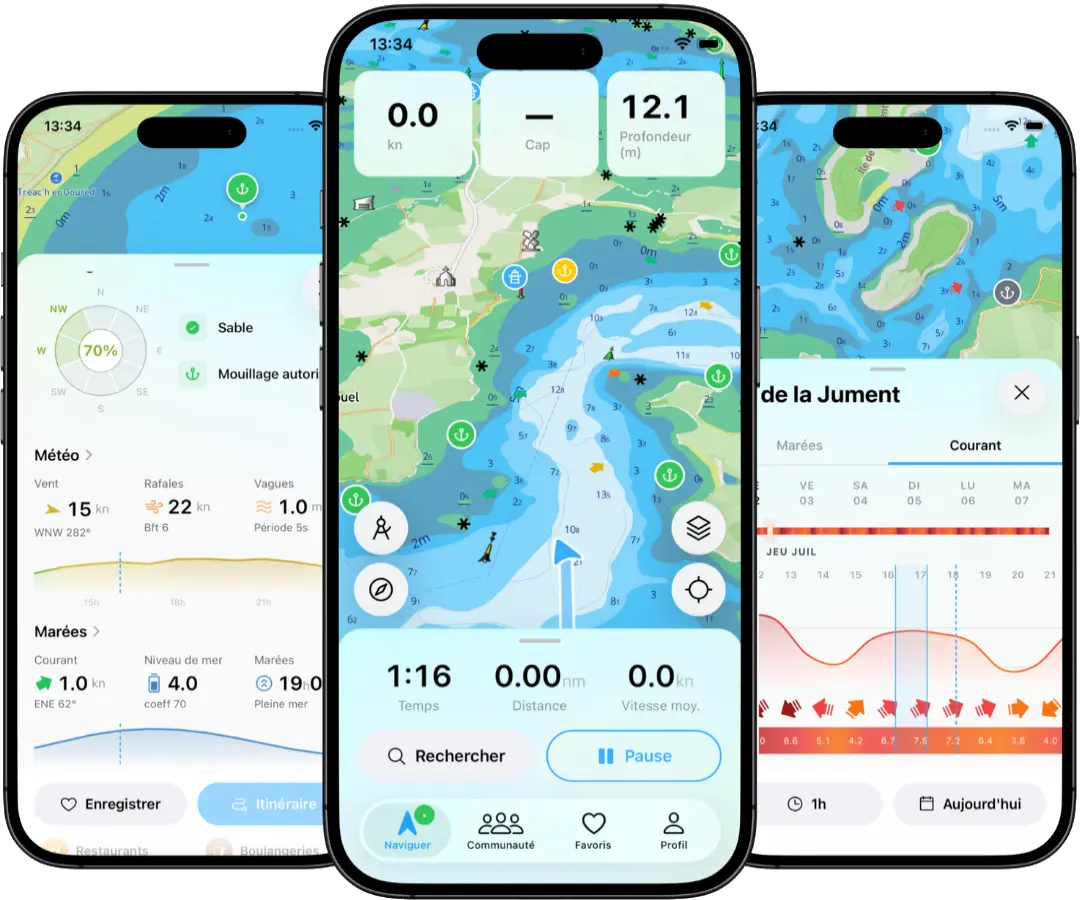
The reason a hiking app ends up on so many anglers' phones is that for years nothing else listed where a kayak could go in. That is changing. In the US, BoatMap puts boat ramps and launch points on the same map as the marinas and anchorages, with reviews and photos from other boaters, such as whether the ramp dries at low water or whether there is somewhere to leave a car; the coverage is laid out region by region, from the Chesapeake to Puget Sound. Tap a ramp for the forecast at that spot, with the wind by the hour, which on a kayak is the only forecast that matters. The free version does that; the paid plan adds the official NOAA charts and offline use for the creeks without signal. For the rest of the phone, our first-season apps guide covers charts, tides and weather.
Add the put-ins you find to the map, with a photo of the mud at low water. The next angler with 103 lb on a cart will thank you.