I will say the thing nobody at the marina bar wants to hear first: the posidonia ban is a good law, and visiting boaters who moan about it are mostly moaning about losing a privilege they should never have had. I have torn up seagrass with my own anchor, before I knew what it was, and watching the meadow not grow back over the following seasons cured me of any sympathy for the argument that the sea is too big to damage. It isn't. We did the damage. The law is the bill arriving.
That said, the law is genuinely confusing for a visitor, the thresholds are inconsistent from one stretch of coast to the next, and the penalties are severe enough that confusion is expensive. So here is what you actually need to know before you cruise French Mediterranean waters.
What posidonia is, and why France protects it
Posidonia oceanica is not a weed. It is a flowering plant, endemic to the Mediterranean, that forms vast underwater meadows between roughly 5 and 35 metres of depth. Those meadows are the nursery and oxygen factory of the coastal sea: they shelter fish, stabilise the seabed, and store carbon. They also grow at a glacial pace. A meadow scoured out by anchors can take centuries to recover, and some of the older Mediterranean beds are estimated to be thousands of years old.
An anchor and chain dragged across that, multiplied by every boat in every bay every August, strips the seabed bare. France classified posidonia as a protected species, which is the legal hook that turns careless anchoring into an offence against a protected organism rather than a mere mooring infraction.
The decree, in plain language
The framework is Decree 123/2019, issued by the maritime prefect for the Mediterranean. It is not a single blanket ban; it is a structure that was then applied through 17 separate prefectural decrees along the coast between 2020 and 2023, each one drawing specific no-anchor zones onto the chart for its stretch of water.
The thing to grasp is that the rule is local. There is no single line that applies everywhere. What is banned off Cannes is defined by the Cannes-area decree; what is banned off Saint-Tropez by another. This is why a general pilot book cannot keep you legal and why you have to check the current zone for the specific water you are in.
The 24-metre threshold and why it confuses everyone
Here is where visitors trip up. The headline often quoted is that the ban targets vessels over 24 metres, and many smaller-boat sailors hear that and conclude it does not apply to them. That is a dangerous misreading.
Two things are true at once. First, the strictest, most explicit prohibitions and the largest fines are aimed at large vessels over 24 metres, with some local zones lowering that bar to 20. Second, anchoring on protected posidonia is an offence against a protected species regardless of your boat's length. A 10-metre yacht that drives its anchor into a seagrass meadow inside a protected zone has still damaged a protected species. The big-boat threshold determines which specific zonal prohibitions and which penalty tiers apply; it does not hand small boats a free pass to anchor on the grass.
The practical reading for a visitor on a normal cruising boat: behave as though anchoring on posidonia is forbidden to you, everywhere, because in substance it is.
The fines are not a token
People assume French enforcement is theatrical and the fines are notional. They are not. The penalties cited for the largest vessels run up to 150,000 euros, with the possibility of being banned from French waters and, where the offence is treated as harm to a protected species, criminal exposure including imprisonment. Lower position-infraction figures in the tens of thousands of euros appear in the local rules. Even at the bottom of that range, the fine is several years of marina nights.
I have not seen the maximum handed out to a small leisure boat, and I suspect the headline figures are mostly a stick for the superyacht trade. But the offence framework applies, the patrols are real, and the gamble is asymmetric: you save one marina fee and risk a number with a lot of zeros. That is not a bet I take.
How to anchor legally, step by step
This is the part that matters, because the law is not asking you to stop anchoring. It is asking you to anchor on sand.
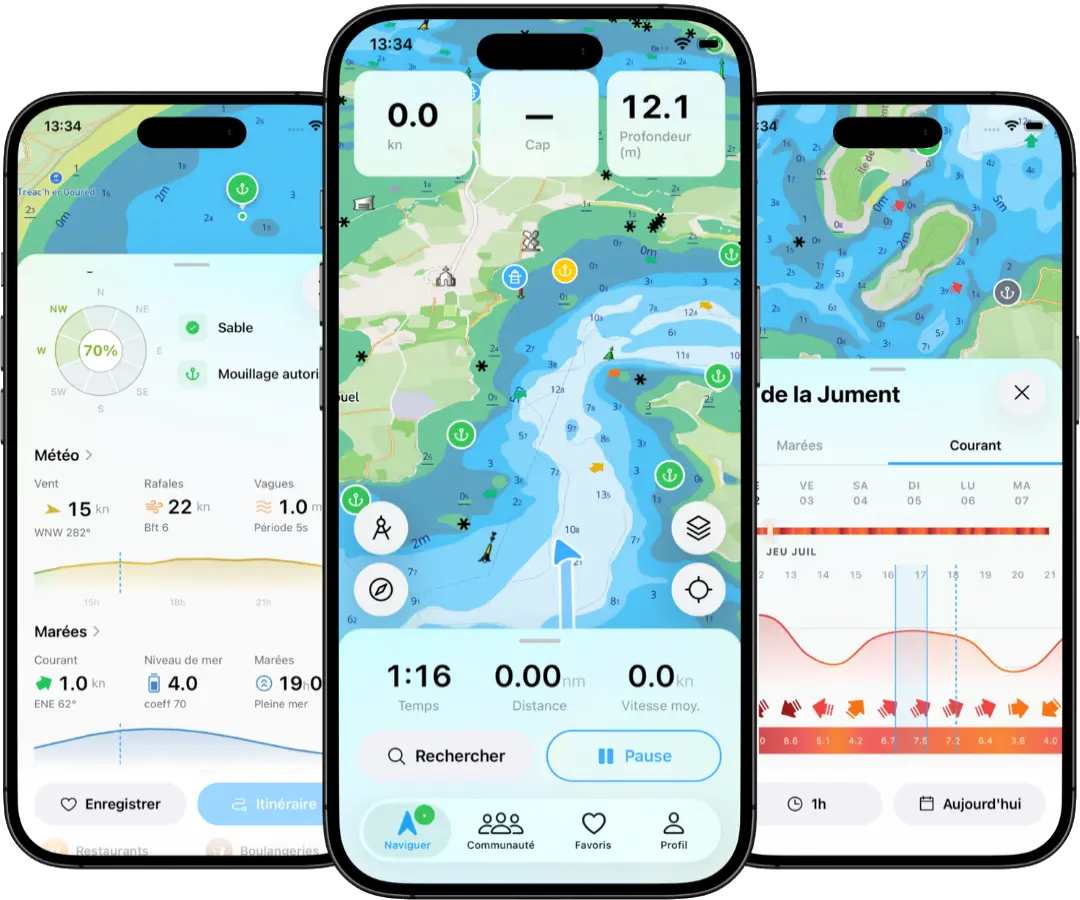
- Before you choose a bay, check the current no-anchor zones. The official Nav & Co app shows the regulated areas for French waters and updates as the decrees change. Do not rely on last season's screenshot.
- In the bay, identify the seabed. Donia, the app most Med boaters use with tens of thousands of users, overlays seabed type onto the chart so you can see grass versus sand before the hook goes down.
- Trust your eyes for the last few metres. The water here is clear; in good light and polarised sunglasses you can read a pale sand patch against dark seagrass in 5 or 6 metres easily.
- Drop on the sand patch, not the edge of the grass, and lay your chain so it does not sweep onto the meadow as you swing.
- If a regulated mooring zone (ZMEL) exists, take a buoy instead. Many are free; some are time-limited.
That is the whole discipline. It costs you ten minutes and the price of nothing, because both apps are free.
The mistakes I see visitors make
After five seasons watching boats arrive in these bays, the errors repeat themselves. The most common is anchoring on the edge of a sand patch with the chain laid out across the grass, which damages the meadow just as surely as dropping the hook into it. Lay your scope where the chain will sit on sand through the full swing, not just where the anchor lands.
The second is assuming a marked mooring buoy is decorative or private and dropping an anchor next to it instead. In an organised zone the buoy is the legal mooring and your own anchor on the seabed beside it may not be. Take the buoy.
The third, and the one that catches northern European sailors most, is treating the seabed as if it were Channel mud. In tidal waters you anchor in mud, it holds, you sleep. Here the holding on clean sand is good but the surrounding seagrass is both legally off-limits and, frankly, poor holding anyway because the anchor skates over the rhizome mat. The grass is not an alternative seabed. It is the thing you avoid.
One small piece of reassurance: nobody expects you to be a marine biologist. The apps do the identification for you, and in clear water your own eyes finish the job. The system is designed for ordinary boaters to get right, and getting it right is genuinely easy once you have done it twice.
What I think comes next
The direction of travel is one way. More zones, more eco-moorings, tighter time limits. The authorities have already signalled a coming 72-hour cap on unattended mooring in the regulated areas, which will end long stays swinging on the hook in popular bays. I expect the free-anchoring water on this coast to keep shrinking through the decade.
You can read that as a loss, and the bar-stool sailors do. I read it as the price of the meadows still being there at all. I would rather take a buoy in a managed zone over living seagrass than drop a free anchor over a dead seabed I helped to kill. If you want to see how this plays out in practice, the current map of where Cote d'Azur anchoring is still allowed in 2026 shows the legal sand and the organised zones, and the Lerins islands anchorage off Cannes is a clean example of the new regime working. For the wider picture of cruising this coast under the current rules, start with my French Riviera sailing guide.
Anchor on sand. Run the apps. Take the buoy where one exists. The meadows are worth the small inconvenience, and so is the size of the fine you will not be paying.