A friend of mine, an experienced Solent sailor, motored into a bay near Cap Ferrat last June, dropped his anchor onto what looked like perfectly good seabed, and was politely told by a passing patrol that he had just dug into protected seagrass and could, in theory, be looking at a five-figure fine. He hadn't done anything reckless. He had done exactly what the pilot book from 2016 told him to do. The pilot book was out of date, and that is the whole problem with anchoring here now.
So this is the practical version, current for the 2026 season: where you can still legally drop the hook on the Cote d'Azur, where you cannot, and the tools that keep you on the right side of it.
The one rule under everything: stay off the grass
Almost every anchoring restriction on this coast traces back to a single plant. Posidonia oceanica is a slow-growing seagrass that carpets the Mediterranean seabed, roughly between 5 and 35 metres of depth, and it is legally protected. An anchor dragged through it tears out plants that can take centuries to regrow, and the French state has decided, reasonably, that it would like them to stop being torn out.
The legal spine is the maritime prefect's Decree 123/2019, which was put into force through 17 separate prefectural decrees up and down the Mediterranean coast between 2020 and 2023. The decrees draw lines on charts: inside certain zones, anchoring over seagrass is prohibited outright. The headline threshold targets vessels over 24 metres, with some local areas tightening that to 20, and the penalties for harming a protected species reach fines in the tens of thousands of euros, vessel bans, and in the worst cases criminal liability. I cover the full mechanics in the posidonia anchoring ban every visitor must know; here I am concerned with the simpler question of where the hook can still go down.
Where you can still anchor freely
The good news, and it is genuinely good news, is that anchoring is not banned. Anchoring on posidonia is banned. The two are not the same thing, and the difference is the difference between a legal night at anchor and a fine.
You can still anchor freely on sand. Most of the Riviera's best bays have a sand bottom somewhere, usually inshore of the seagrass line or in the patches the grass never colonised. The technique that keeps me legal is dull and effective: I motor slowly over the spot in clear water, I look down (or I check the app), I find a pale sand patch with no dark fronds waving in it, and I drop there. The water on this coast is clear enough that on a calm day you can eyeball the bottom in 5 or 6 metres with no trouble at all.
Some reliable sand:
- The southwest side of Sainte-Marguerite in the Lerins, 3 to 6 metres over sand
- The sandy southern end of Pampelonne bay, with the seagrass concentrated to the north
- Patches in the Gulf of Saint-Tropez bays, between the grass beds
The organised zones: where the choice is made for you
The other thing that has changed is the spread of organised mooring zones, the ZMEL (zone de mouillage et d'equipements legers). Instead of letting everyone scatter anchors across the seabed, the authorities lay permanent eco-moorings, fixed to rock or designed not to touch the grass, and channel boats onto buoys. You take a buoy instead of dropping your own anchor.
These zones are spreading fast. At Cannes, the city created a ZMEL in the Anse Sainte-Anne on the north side of Sainte-Marguerite: a five-hectare area for around 28 vessels between 6 and 20 metres, where the buoys are free, but use is capped at 7 consecutive nights and 21 nights a season, with a two-night gap between stays. You declare your arrival to the Mouré Rouge port office on VHF channel 9. At Pampelonne, Ramatuelle installed a much larger system for the 2025 season: 210 moorings taking boats from 7 to 80 metres, each on a single anchor point fixed into rock with no concrete and no contact with the seagrass.
My honest take on these zones is mixed, and I will defend it. They are the right answer for the seabed and the wrong answer for the spontaneity that made Mediterranean anchoring special. You used to arrive at a bay and choose your spot. Increasingly you arrive at a bay and take the buoy you are given, or you go elsewhere. I would rather take a buoy than kill a seagrass meadow, so I take the buoy. But I miss the old freedom, and I am not going to pretend the new system is purely a gain. It is a trade, and the seabed got the better half of it.
The tools that keep you legal
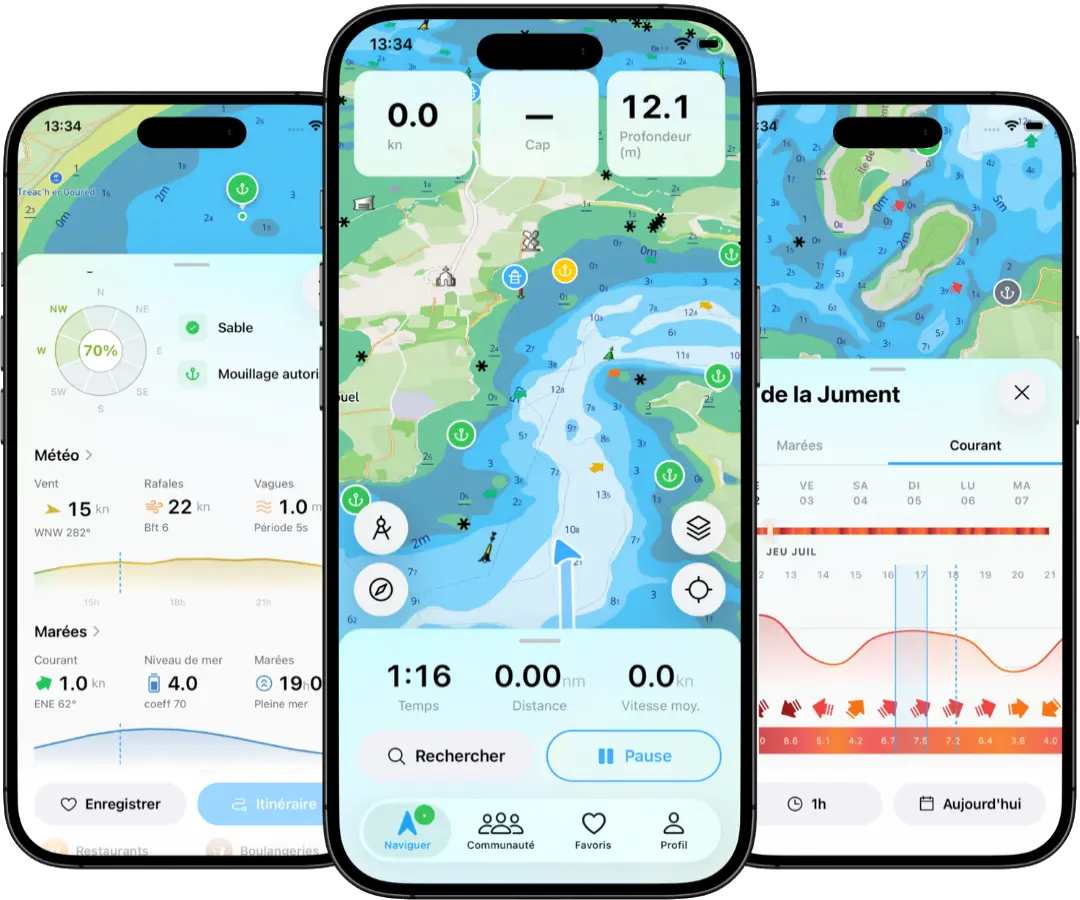
You cannot tell seagrass from sand from the cockpit at any distance, so you need help. Two apps do the job.
Donia is the one most Med boaters use, with tens of thousands of users, and it overlays the seabed type onto the chart so you can see the grass before you commit. Nav & Co, the official French maritime authority app, shows the regulated anchoring zones and updates as the decrees change. I run Donia for the seabed and cross-check the zone boundaries against the official source, because the lines on the chart move every season and a screenshot from last year is worth nothing.
On the boat itself, clear water and a pair of polarised sunglasses do a surprising amount of the work. In good light I can read the bottom directly and I trust my eyes over any app for the final few metres. The app gets me to the right bay; my eyes choose the patch.
A few honest warnings
The 72-hour rule is coming. The authorities have signalled they intend to cap unattended mooring at 72 hours in these zones, which will end the practice of leaving a boat swinging on the hook in a popular bay for a week. If you are planning a long stay at anchor, do not assume it will still be allowed.
Enforcement is real and it is patchier than you would hope, which is the worst combination. Some weekends a patrol works a bay hard; other weeks nothing. Do not gamble on the gap. The fine for getting it wrong dwarfs any marina bill you were trying to avoid.
And the charts in your old pilot book are not the law. The law is the current prefectural decree for that stretch of coast, and the only way to know it is the official app or the harbour office. When I am unsure, I call the local capitainerie on channel 9 and ask. They would far rather tell you where to anchor than fine you afterwards.
The short version
Stay off the seagrass, anchor on sand, take the buoy where a zone exists, run Donia and the official app, and call the harbour if you are not certain. Do that and the Cote d'Azur is still one of the great anchoring coasts in Europe. Ignore it and the bill will ruin your week. For the etiquette of actually sharing these increasingly crowded bays once you have found a legal spot, I have written separately on anchoring etiquette on a crowded Riviera bay. And if all of this has you wondering whether to skip the hook entirely, the wider context is in my French Riviera sailing guide.