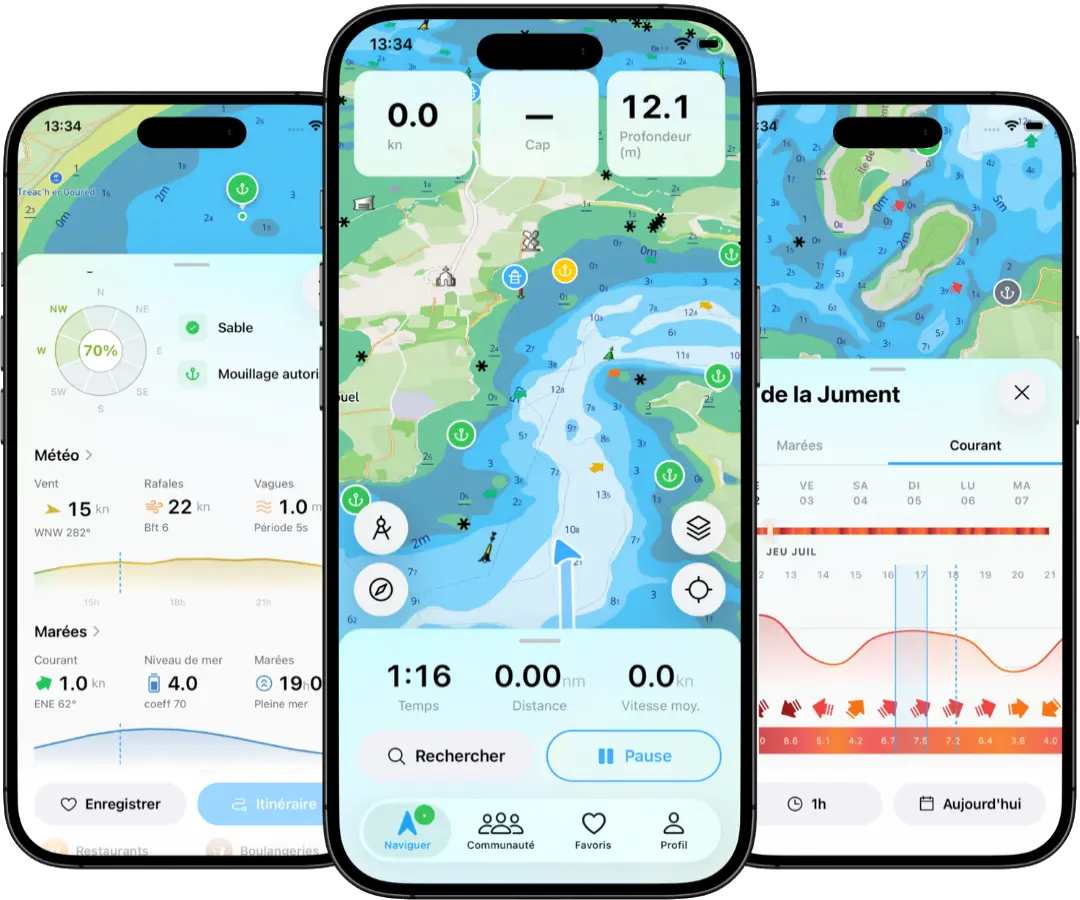
The Gulf of Morbihan does one thing that no pilot book quite prepares you for: it makes you feel like you are sailing inland. You come through a gap less than a kilometre wide, the Atlantic swell vanishes behind you, and suddenly you are threading between forty-odd low green islands on flat water, with herons on the mud and oyster trestles drying in the sun. The name means "little sea" in Breton, and that is exactly what it is.
It is also a tidal trap for the unwary, and the difference between a magical week and a frightening hour comes down to one number on the tide table.
The entrance: respect the gap
Everything starts at the mouth, between Port-Navalo on the Rhuys peninsula and Kerpenhir at Locmariaquer. The opening is only about 900 metres wide, and the entire gulf, several square miles of it, fills and empties through that throat twice a day. The result is one of the strongest tidal streams in Europe.
At mid-springs the flood or ebb reaches up to 8 knots in the narrows. Inside, between the Ile de la Jument and the Ile Berder, the famous Jument current regularly exceeds 9 knots at the top of the tide. Those are not numbers you push against. A boat that cruises at 6 knots simply goes backwards over the ground, and the overfalls where the stream meets a contrary wind can be genuinely dangerous in a small yacht.
The rule I sail by, and the one every local will give you: enter on the last of the flood and leave on the last of the ebb, so the stream is with you through the narrows and slackening as you go. Plan your arrival for slack water or the gentle end of the tide, never the springs peak with wind against tide. If you have come down the coast and your timing is off, wait it out at the Le Crouesty marina just outside, take the next tide, and lose nothing but a few hours.
Tides here are given as a French coefficient. Above about 95 is a big spring and the streams run at their fiercest; below 45 is a slack neap and the whole gulf becomes forgiving. Read the coefficient before you read anything else. If the system is new to you, the primer on reading a French tidal coefficient is worth the detour.
The range catches people too
The tidal fall inside the gulf can reach 4 metres or more on a big coefficient. That sounds modest after Saint-Malo, but it transforms the anchorages. A bay carrying 3 metres at high water can be a sheet of glistening mud six hours later, and several of the prettiest spots dry completely.
So sound everything on a falling tide, allow for the range plus your draught plus a margin, and assume any chart depth you read is the start of a calculation, not the answer. I keep the tide curve open on the chart plotter the whole time I am inside, because the streams between the islands can still run 2 to 3 knots even well away from the entrance.
Where to drop the hook
The gulf rewards a boat that anchors rather than one that marina-hops, and there is far more water than the casual visitor expects once you learn to read it.
Ile aux Moines and Ile d'Arz are the two largest islands and the obvious first anchorages. The channel between them carries good water and there are bays on both that give shelter from the prevailing west to northwest wind. Ile aux Moines has a small village, a couple of cafes and a regular passenger ferry, so it makes an easy first night with the dinghy ashore for bread and a beer.
For something quieter, the bays on the eastern side, around the Ile de Boede and the approaches to the Riviere de Noyalo, empty out in the evening once the trip boats have gone. Holding is generally good in sand and mud, but patchy where the eelgrass grows, and the gulf takes its seagrass seriously: in protected zones you are expected to pick up a mooring rather than anchor on the weed. Carry enough chain to lie comfortably and check what you are dropping onto.
Anchoring well in these waters is a skill in itself, and the wider piece on anchoring in Brittany covers scope, holding and the etiquette of crowded bays.
Ile aux Moines, Arz and the smaller bays
It is worth saying more about the two main islands, because they set the tone for the whole gulf. Ile aux Moines is shaped like a cross and has the busier village, a passenger ferry running across the narrows from Port-Blanc, a couple of small shops and cafes, and woods and beaches you can walk between in an afternoon. The bays on its western side give shelter from the prevailing wind and make an easy first or last night. Ile d'Arz across the channel is quieter and lower, with a tidal mill at its southern tip and far fewer trippers.
Between and around them the gulf hides dozens of nooks. The water off the Ile de Boede, the reaches up towards Noyalo, and the bays on the Rhuys shore all empty out in the evening. Pick one that gives a lee for the forecast wind, sound it on the falling tide, and you can have a corner of the little sea to yourself. The streams here, even well inside, can run 2 to 3 knots between the islands, so always know which way the tide is setting before you commit to a narrow gap under sail.
Provisioning and going ashore
You are never far from a baguette in the Morbihan. Ile aux Moines, Larmor-Baden, Arzon and of course Vannes all have shops, and the oyster beds you sail past supply the restaurants you eat in. The trip boats and the small passenger ferries criss-crossing the gulf are part of the scenery, but they also mean you can leave the boat on a buoy and get ashore easily. Keep a good lookout for them in the channels, particularly around Port-Blanc and the entrance, where the ferry traffic and the strong stream combine.
Vannes at the top of the gulf
You can sail almost all the way to a medieval city. The channel up to Vannes is buoyed and the marina sits right inside the old ramparts, reached through a swing bridge that opens on a schedule tied to the tide. Berthing under the walls of a walled town, a short walk from the cathedral and the half-timbered houses, is one of the better arrivals in French waters. Confirm the bridge times with the capitainerie on VHF 09 before you commit to the channel, because you do not want to be hanging around in a narrowing, drying creek waiting for an opening you have missed.
Vannes also makes a sensible provisioning stop. There is a proper city behind the marina, a Wednesday and Saturday market, chandlers and supermarkets within walking distance, and good rail links if you are swapping crew.
A week well spent
The Morbihan suits a slow week. Come in on a kind tide, take a night at Ile aux Moines, a night somewhere quiet on the east side, push up to Vannes for the city and the markets, then drift back down catching the ebb out through the narrows when the coefficient is gentle. Do not try to see all forty islands. Half the pleasure is sitting at anchor watching the water sluice past, glass in hand, glad you are not out in it.
Most cruisers fold the gulf into a wider south Brittany cruising guide, pairing it with a run out to Belle-Ile-en-Mer or the low sandy islands of Houat and Hoedic just outside. The gulf is the calm heart of that cruise. Time the tide, respect the gap, and it is as gentle a piece of water as you will find anywhere in France.