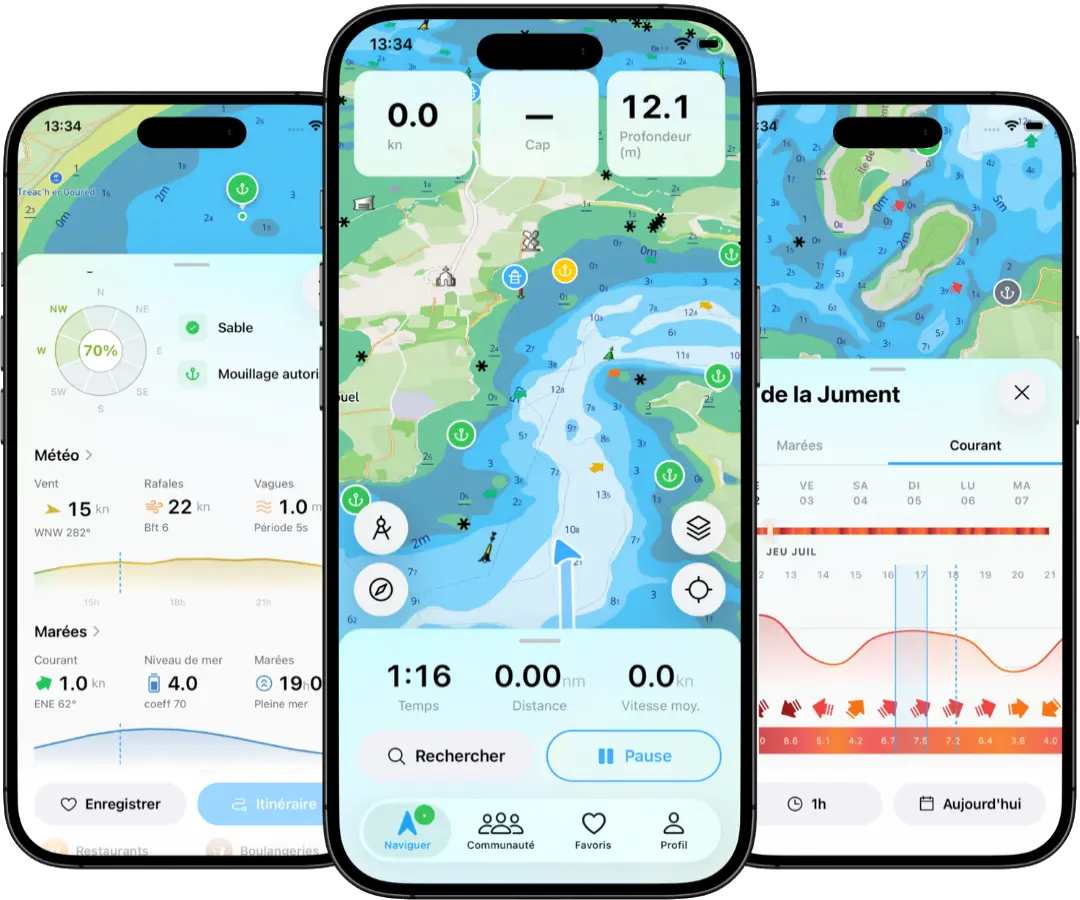
Nine miles offshore from the Quiberon peninsula, Belle-Ile rises out of the haze like a proper island should: cliffs on the seaward side, a couple of snug harbours tucked into the lee, and enough length to it that you can spend three days and not see the same bay twice. It is the largest of the Breton islands, and for my money the best single destination in south Brittany if the forecast gives you a settled window to cross.
That settled window is the catch. Belle-Ile sits out in the open, and the passage from the mainland is short but exposed. Get the weather right and it is an hour and a half of easy sailing. Get it wrong and the south coast cliffs offer nowhere to hide.
Getting there
The crossing from the Bay of Quiberon or from Le Crouesty runs to roughly 9 to 14 miles depending on where you start, well within a morning. The water is deep almost all the way, so the planning is about wind and sea state rather than tidal gates. The stream off the Quiberon peninsula runs a couple of knots and is easily allowed for.
What you want to avoid is a strong southwesterly with any sea running, because the harbours of choice both face roughly north and a big swell wrapping round makes the approaches lumpy. I cross on a forecast of force 4 or less and a falling sea, and I do it in the morning so I have the whole day to settle in. The piece on picking a Channel crossing weather window applies just as well to any short offshore hop like this one: look at the swell as hard as the wind.
Le Palais: the main harbour
Le Palais is the island's capital and its principal port, dominated by the great star-shaped Citadelle Vauban above the harbour. It is busy, it is the ferry terminal, and in August it can be a scrum, but it is also the all-weather option and the place to provision.
Visitor berthing comes in layers. There are visitor buoys on the north breakwater taking boats up to about 3 metres draught, and more on the breakwater for shallower boats up to 2 metres on modular pontoons with shore access. Inside there are roughly 90 places afloat, rafted in pairs along the pontooned quays with water and electricity, taking up to 2.5 metres. Call the harbour master on VHF 09 before you commit, because the allocation depends entirely on how full it is, and in peak season you will likely raft up several boats deep.
Fuel is self-service at the Bonnelle quay, and you berth there only after the harbour master agrees it on VHF 09, so do not just barge in. The town behind has everything: market, supermarkets, restaurants, banks, and the walk up to the Citadelle is worth the hour.
Sauzon: the prettier option
If Le Palais is the practical choice, Sauzon is the one you remember. It is a small drying harbour on the north coast, a curve of pastel houses around a creek that empties to mud at low water, and on a calm summer evening it is about as good as harbour life gets.
The trade-off is depth and size. Sauzon dries, so it suits a boat that can take the ground or one content to lie to a visitor buoy in the deeper outer part. The front of the port has around 40 visitor places on white buoys for monohulls up to 12.5 metres and 2 metres draught, with another 60 or so on red buoys in the drying section and room to anchor beyond the last line of buoys towards the Pen Prad basin. Report your arrival to the harbour office on VHF 09. Get there early in the season's peak weeks, because those white buoys go fast.
Soundings matter here. The harbour carries enough water near high tide but the inner reaches dry hard, so know your draught, watch the tide curve, and do not pick up a red buoy unless you are happy sitting on the bottom.
Fuel, water and provisions
Le Palais is your supply base. Fuel comes from the self-service berth at the Bonnelle quay, taken only after the harbour master agrees it on VHF 09, and water and power are on the inner pontoons. Sauzon has more limited facilities, so top up the tanks at Le Palais before you move round to the quieter harbour, and carry enough provisions that you are not forced back into the busy capital just for bread. The Tuesday market in Le Palais is the place to stock up on the good stuff, local produce, cheese and the seafood the island does so well.
Anchoring around the coast
Beyond the two harbours, Belle-Ile has a string of bays that work as daytime or fair-weather anchorages. The northern and eastern bays give shelter from the prevailing west to northwest wind, and on a settled day you can drop the hook off a beach, swim, and have the place to yourself once the day boats leave.
Holding is generally good in sand, patchier over weed, and the usual Breton rule applies: sound on a falling tide and allow for the range, which runs to several metres on a big coefficient. None of these open bays is a place to leave the boat unattended overnight if the wind is forecast to back into the west, so keep an eye on the barometer and have Le Palais as your bolt-hole. For the broader approach to dropping the hook in these waters, the anchoring in Brittany piece covers scope and weed.
Reading the weather out here
Because Belle-Ile gives so little all-weather shelter outside Le Palais, the weather watching does not stop when you have anchored. The island sits in the open Atlantic and the forecast can turn faster than it does inshore. I keep a close eye on whether the wind is due to back into the southwest or west, because that is when the north-facing harbours start to feel the swell wrapping round the headlands.
Sauzon in particular is a fair-weather delight and a poor place to be caught out. If the barometer drops and the forecast firms up from the west, I lift off the buoy and run round to Le Palais, which can take a blow, or back to the mainland while the crossing is still comfortable. The general approach to reading a marine forecast in these waters is covered in the piece on French marine weather forecasts in English, which is worth bookmarking before any offshore hop.
Ashore on the big island
Belle-Ile rewards a couple of days off the boat. Hire bikes or walk the coastal path to the Aiguilles de Port-Coton, the sea stacks Monet painted, which are a short ride from Le Palais. The island has proper restaurants, a Tuesday market in Le Palais, and enough back lanes and beaches that you can lose an afternoon happily. The crews who give it three nights and treat the crossings as part of the holiday, rather than rushing out and back in a day, are the ones who come away wanting to return.
Most visitors fit Belle-Ile into a wider south Brittany cruising guide, pairing it with the calmer waters of the Gulf of Morbihan just inshore, or with a night at the racing town of La Trinite-sur-Mer on the way out. Belle-Ile is the offshore prize. Wait for the weather, take the morning crossing, and give it more time than you think you need.