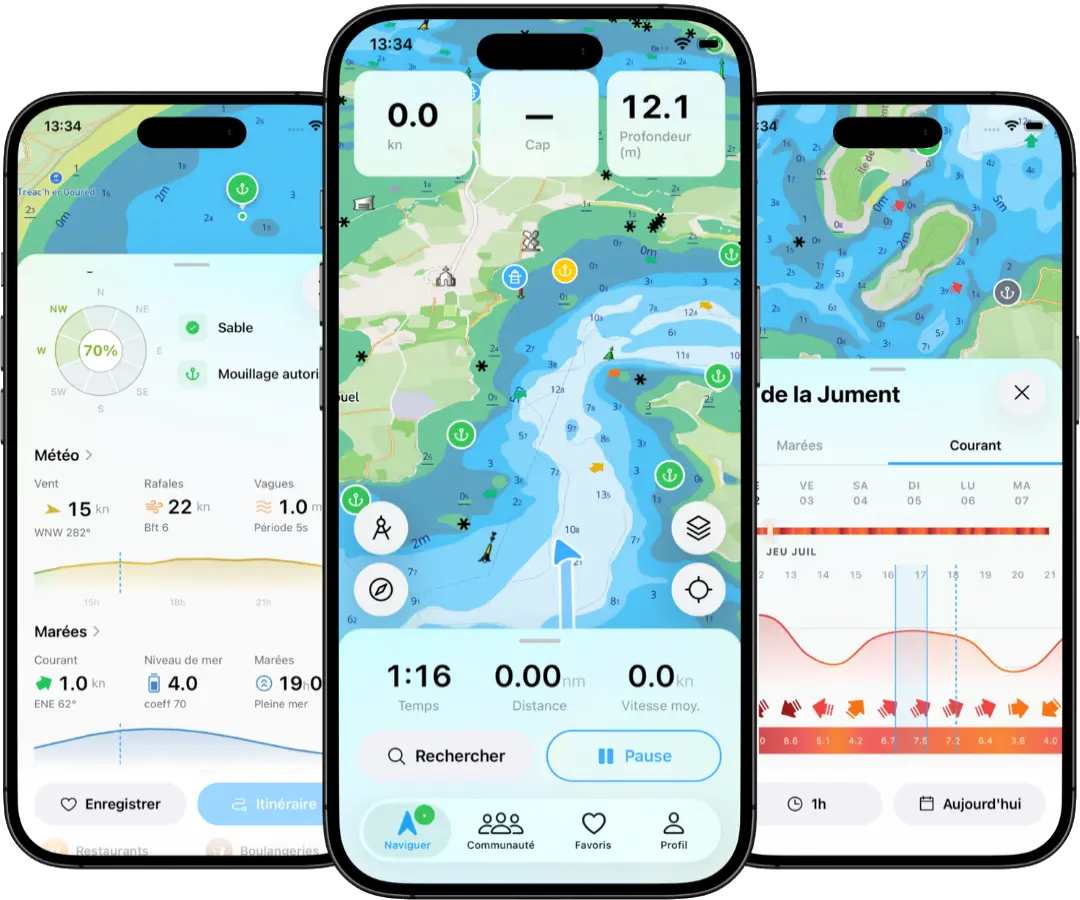
The first season I cruised Brittany, I dragged twice. Once off a beach where I had dropped the hook into what I thought was sand and was actually a thick mat of kelp, and once because I let out the scope I would have used in the Solent and forgot that the water under me was going to rise another four metres on the flood. Both were avoidable. Anchoring in Brittany is not hard, but it rewards three habits that Mediterranean and tideless-water sailors tend not to have drilled into them: reading the bottom, calculating scope against a serious tidal range, and respecting your swinging circle as the tide turns.
The bottom: sand good, weed bad, rock worse
Brittany's seabed is a patchwork. You get beautiful clean sand in the bays, you get kelp and eelgrass over rock on the edges, and you get bare rock where you really do not want your anchor. The skill is telling them apart before you commit.
On a bright day with the sun behind you, the water reads like a map. Sand reflects light and shows up as pale, almost turquoise patches; weed and rock absorb it and show dark. Steer the boat over the lightest water you can find and let go there. Drop into a dark patch and one of two things happens: your anchor skates across the top of the kelp without ever setting, or it hooks a rock you then have to dive for in the morning.
Gear matters in weed. The old CQR and the Bruce are fine in mud and sand but neither cuts through a heavy weed mat well. A modern scoop-type anchor (Rocna, Spade, Delta and the like) with weight behind it does better, but no anchor reliably sets through thick kelp, so the real answer is not a cleverer anchor, it is choosing sand in the first place. When you must drop near rock or weed at the edge of a bay, buoy the anchor so you can trip it if it fouls.
Once it is down, set it properly. Pay out the scope, let the boat settle head to tide or wind, then go astern on the engine and watch a transit ashore. If the transit holds while the chain comes up bar-taut, you are dug in. If the boat keeps creeping, you are not, and no amount of hoping will fix it. Reset.
Scope and the tidal range that catches people out
This is the one that bites visitors from tideless waters. Brittany has a big tidal range. The north coast is the extreme case, Saint-Malo sees water rise as much as 13 metres over six hours on the biggest springs, the largest range in Europe, but even on the gentler south coast you are routinely dealing with several metres between low and high water.
That changes the maths in two ways. First, your scope. You calculate chain against the maximum depth you will sit in, which is the depth at high water, not the comfortable two metres you see when you drop at low tide. Drop in 2 metres at low water on a 4-metre range and you will float in 6 metres at high water; if you let out scope for 2 metres, you have a 1.5:1 ratio at the top of the tide and you will drag. Work on at least 4:1 in chain against the high-water depth, more if it is blowing or the holding is doubtful.
Second, your depth under the keel at low water. The flip side of the same problem: drop in 6 metres at high water and that same spot might be 2 metres, or drying, at low water. Check the range for the day, work out what you will have under you at the next low, and make sure it is more than your draft plus a safe margin. The French tidal coefficient is the quick guide here: it runs from around 20 (small neaps) to 120 (big springs), and above roughly 100 you are in serious-range territory and need to do the arithmetic carefully.
Swinging room and reading the tide turn
In a tidal anchorage the boat does not sit still pointing one way. It swings through the tide. On the flood it lies one way; the stream slacks, the boat hangs to the wind, then the ebb takes it and it lies the other way, often through 180 degrees. You need clear water all the way round that circle, not just downwind of where you dropped.
Two practical consequences. Allow for the full swing when you judge distance from your neighbours, the shore and any drying patch, and remember that other boats with different windage and chain will swing at different rates, so you can lie close together happily on one tide and clash on the next. And watch the slack-water moment: that is when boats that anchored too close discover the problem, as everyone lies to wind rather than tide and the tidy fore-and-aft line collapses into a muddle.
Carry enough chain. Visitors used to short Mediterranean rodes are often under-equipped for Brittany. Boats cruising the Channel Islands and north Brittany routinely carry 80 metres of chain, because the depths and ranges demand it. You do not always need to use it all, but you want it on board.
A practical routine when you arrive
Here is the sequence I run every time, and it has stopped me dragging since that first season. Before I even reach the bay I look up the day's coefficient and the times of high and low water. I work out the depth at the moment I will drop and the depth at the next low, so I know both the deepest figure (for scope) and the shallowest (for keel clearance). Then, coming in, I make a slow pass over the chosen spot watching the sounder and the colour of the water, and I pick the palest sand with the most swinging room.
I drop with the boat stopped or just gathering sternway, never with way on, paying the chain out steadily so it lies along the bottom rather than piling on top of the anchor. Once the scope is out I snub it, let the boat take up, then go gently astern to dig the anchor in and hold the revs for fifteen or twenty seconds while I watch a transit ashore, two fixed objects in line. If they stay in line, the anchor is set. Then I note the position on the plotter, set an anchor alarm with a generous radius for the swing, and only then put the kettle on. Total time, five minutes. It is the cheapest insurance in boating.
Marina, mooring or hook
Brittany gives you all three and the choice is partly about money and partly about weather. A visitor pontoon berth in south Brittany in 2025 runs broadly 30 to 45 euros a night for an 11 to 12 metre boat, sometimes more in the smart resort marinas in August. A harbour mooring buoy is cheaper, an anchorage is free. But the anchorages out here are fair-weather propositions, open to the sea, so the calculation is not just cost: it is whether you trust the forecast to sit out a night unattended on your own ground tackle.
My rule is simple. Settled high pressure, light to moderate winds from a kind direction, good sand under me: I anchor, and happily. Anything unsettled, a front forecast, or an anchorage open to the wind that is coming: I pay for the pontoon or the buoy and sleep. The money saved by anchoring through a bad night is the worst kind of false economy.
Putting it into practice
The pay-off for all this care is some of the best anchoring in France. The sandy bays of the offshore islands are the prime exhibits, and the holding off the great beach at Houat and Hoedic is clean sand that any decent anchor will bite, provided you read the colour and put in the scope. The rivers are gentler still: the wooded reaches of the Odet river to Quimper give sheltered overnight holding once you are clear of the fairway, with none of the swell of an open coast.
If you are basing yourself on the south coast, a working harbour like Concarneau marina makes a good place to top up, study the next day's coefficient, and choose your bay accordingly. And if you have only just brought a boat to these waters, check the ground tackle and chain locker honestly, the same surveyor's eye I describe in the used sailboat hull inspection guide should land on your anchor windlass and chain as much as on the hull.
None of this is complicated. Read the bottom and aim for sand. Calculate scope against the high-water depth, not what you can see now. Check you will float at low water. Allow for the full swing. Set the anchor hard astern and watch a transit. Do those five things and Brittany becomes the rewarding cruising ground it is, instead of the place where, like me in my first season, you learn the lessons the hard way at two in the morning.