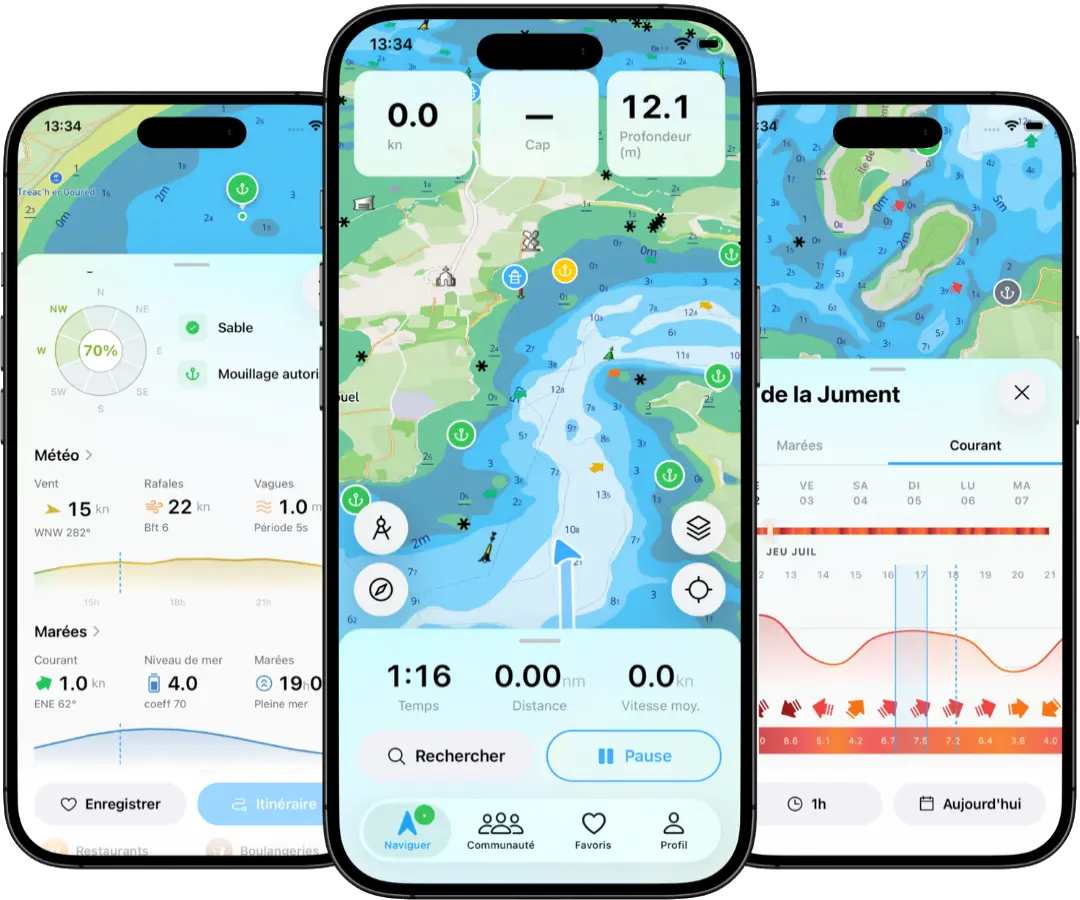
Every French tide table, marina noticeboard and weather app shows a number next to the day's tides that you will not find in a British almanac: the coefficient. The first time I saw it, anchored off the Morbihan with a French neighbour, I asked him what it meant. He looked at me as if I had asked what the sun was. "Ninety-five," he said, "so do not anchor where you cannot float at low water." That one number told him everything. By the end of the season it told me everything too.
If you are cruising France from the UK or coming up from the tideless Med, the coefficient is the most useful local tool you can learn, and it takes about ten minutes.
What the number actually is
The tidal coefficient is a single figure, on a scale from 20 to 120, that tells you how big today's tide is. A high coefficient means a large range, a lot of water rising and falling, and strong tidal streams. A low coefficient means a small range and gentle streams.
It was invented in 1839 by a French hydrographic engineer named Chazallon, who took the average spring tide at Brest as his reference and set it at 100. Everything else is scaled around that. Because it is referenced to Brest, the same coefficient applies along the whole French coast on a given day, even though the actual range in metres differs hugely from place to place. The number is the same at Saint-Malo and at La Rochelle; what changes is how many metres of water that number translates into locally.
That is the elegant part. One national number, read off any tide source, and you instantly know whether it is a big tide day or a small one, wherever you are.
The scale, in plain language
Here is how the official SHOM scale breaks down, with what each band means to you on the water.
- 20: the smallest neap. Barely any range, weak streams. The water hardly moves.
- 45: an average neap. Modest range, easy streams.
- 70: an average tide. The middle of the scale.
- 95: an average spring. Large range, strong streams. This is a serious tide.
- 100 and above: a big spring. The water moves a long way and fast.
- 120: the theoretical maximum, an extraordinary equinoctial spring.
A simple rule many French sailors use: above about 85 you are in spring tides, below about 55 you are in neaps. The closer to 120, the more the tide dominates your day.
What a coefficient does not tell you directly
This trips up newcomers, so be clear about it. The coefficient tells you the relative size of the tide, not the absolute depth at your spot. A coefficient of 95 at Saint-Malo means the water might move 12 metres or more, because Saint-Malo has a colossal local range. The same 95 in southern Brittany might mean 5 or 6 metres, and on the Mediterranean it means almost nothing because the Med barely tides at all.
So the coefficient is your first read, the headline. You still need the local tide table to convert it into actual heights and times for your harbour. Think of the coefficient as the volume knob and the local table as the tune.
If the whole idea of large tides is new to you, read the Atlantic tides crash course first, then come back to the coefficient. The two together give you the full picture.
How I use it in practice
The coefficient drives three decisions for me, every cruising day on tidal coasts.
First, depth and anchoring. On a low coefficient, say 40, I can anchor a bit more casually because the water will not drop far. On a high coefficient, say 100, I work out the low-water depth carefully and add margin, because the sea will fall a long way and I do not want to find my keel in the mud like my Med friend did.
Second, drying harbours and bars. Many of the loveliest French ports dry out, and many estuaries have a shallow bar. On a big coefficient there is more water at high tide, which can help you get in, but also far less at low tide, which can leave you stranded for longer. I plan my arrival and departure around high water, and the coefficient tells me how unforgiving the low water will be.
Third, tidal streams. This is the one Med sailors underestimate. A high coefficient does not just mean a big vertical range, it means fast horizontal flow. In the channels of Brittany the stream can run hard, and the difference between a 50 and a 100 coefficient is the difference between a manageable current and a wall of moving water. Before I take on any of the tidal streams and Brittany gates, I check the coefficient, because on a big spring the gates are narrower and the consequences larger.
A worked example
Suppose tomorrow's coefficient is 102 and I want to leave a drying marina and round a tidal headland.
The 102 tells me immediately: big spring, lots of range, strong streams. I check the local table and find high water at 0930. The drying marina has plenty of water from about two hours before to two hours after high water, so I aim to leave around 0930. The headland's stream turns fair shortly after local high water, so the same departure carries me round with the tide rather than against it. One number set the whole plan in motion, and the local table filled in the minutes.
Now suppose the coefficient is 38. Small neap, little range, weak streams. I have a much wider window at the marina, the headland is benign whenever I get there, and I can plan around wind and breakfast instead of around the tide. The coefficient told me, before I opened anything else, what kind of day it would be.
Where to find it
You are never short of the number in France. Every printed tide table lists it, usually in a column beside the high and low water times. The marina capitainerie posts it on the noticeboard each morning. The free tide apps show it, the SHOM tables give it, and most local newspapers in coastal towns print it next to the weather. Because it is referenced to Brest and applies nationally, the figure you read in a Saint-Malo cafe is the same figure that matters down in La Rochelle that day.
One small habit that paid off for me: I write the day's coefficient on the chart table whiteboard along with the high and low water times. It keeps the headline number in front of me while I plan, instead of buried in an app I have to keep reopening.
A common misreading to avoid
Newcomers sometimes assume a low coefficient means a safe, easy day in all respects. It does mean gentle streams and a small range, which is genuinely easier. But a low coefficient also means less water overall, so on a neap the high water may not lift you over a bar or into a drying harbour that a spring high water would clear comfortably. I have waited out a neap tide outside a sill harbour because there simply was not enough water at the top of the tide to get in, even though the coefficient was a reassuring 35. The number tells you the size of the swing, not whether today's high water happens to be high enough for your particular obstacle. Always convert it to actual metres for your spot.
The habit worth building
Make it the first thing you check each morning, before the weather even. Glance at the coefficient, decide what kind of tidal day it is, and let that frame everything else. On a 40 you relax. On a 100 you respect the water and plan with margin. After a few weeks it becomes automatic, the way my Morbihan neighbour read it: a single number that quietly organises a safe day on a coast where the sea moves more than most visitors can quite believe.
The coefficient also works hand in hand with carrying the right charts for French waters, where the tidal information and the chart datum come from the same official SHOM source, so the depths you read and the tide you predict speak the same language.