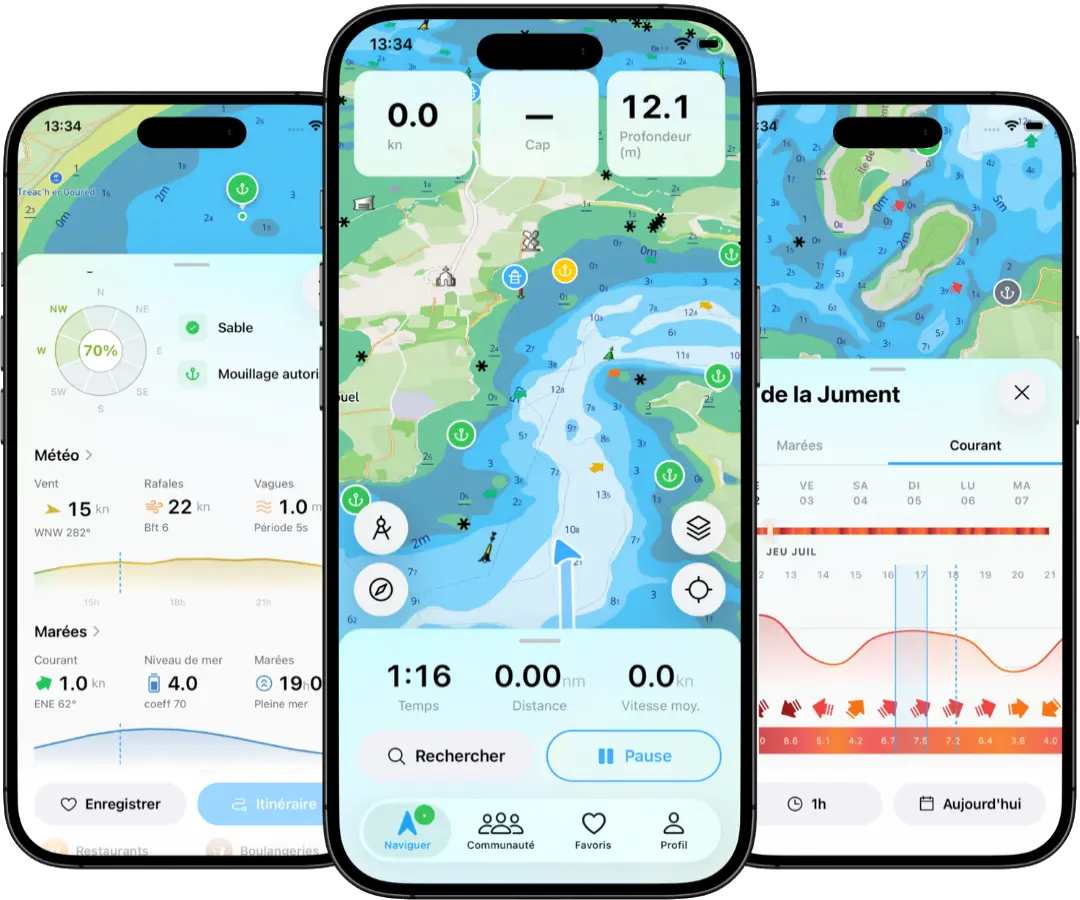
There is a stretch of the north Brittany shore where the granite turns the colour of salmon and the rocks pile up into shapes that look carved by a drunk sculptor. The locals call it the Cote de Granit Rose. It runs about 30 kilometres between Perros-Guirec and Trebeurden, and from the water it is one of the most photogenic coasts in France. It is also a place that punishes the sailor who treats the tide as an afterthought, because almost every harbour along it sits behind a sill or a drying approach.
I came here expecting a postcard and found a navigation puzzle wrapped in pink stone. That combination is exactly why pink granite coast sailing stays with you long after the holiday is over.
Perros-Guirec: the gated marina
Perros-Guirec is the obvious base. The Linkin marina is well sheltered and sits within walking distance of a town that actually has shops, restaurants and a chandlery, which is more than some of the prettier ports can offer. The catch is the gate. It is a flap-gate marina, and the gate stays open for only a window either side of high water, roughly two hours at neaps and up to three hours at springs.
That means your day revolves around the gate times, not your own schedule. Get the timetable from the capitainerie, write it on the back of your hand, and plan your departures and arrivals around it. Miss the window and you are anchoring outside in the roadstead and waiting for the next tide. Call ahead on VHF and confirm; gate times shift with the coefficient and I have seen visitors turn up an hour late and spend a long evening swinging at anchor.
From Perros-Guirec you are well placed to explore the whole coast either side, and the town makes a sensible jumping-off point if you have come down from the Bay of Morlaix and Roscoff and want a base for a few days rather than a one-night stop.
Ploumanach: the rock pool you have to time
If Perros-Guirec is the practical choice, Ploumanach is the romantic one. The approach is a winding marked channel that dries, threading between pink granite humps, and it leads to a pool whose water is held in by a submerged sill. The sill keeps an average depth of around 1.8 metres inside, which limits the draught of boats that can use it and means you can only get in over the top near high water.
Inside, you pick up a fore-and-aft mooring between lines of buoys rather than tying to a pontoon. The harbour has a capacity of roughly 350 places, of which around 200 are afloat on buoys and the rest dry out, with about 20 buoys traditionally kept for visitors. Listen on VHF channel 9 and 16. It is a tight, fiddly entrance and I would not attempt it for the first time in poor light or a swell, but once you are tucked inside with the lighthouse glowing pink at sunset, you understand why people make the effort.
Do not confuse the charm with safety. Get the sill timing wrong and you sit on it. Treat the tide here with the same respect you would give a drying harbour anywhere in Brittany, because that is exactly what this is.
Trebeurden and Trégastel
At the western end, Trebeurden has a marina with a sill and tidal gate of its own, deeper and easier than Ploumanach, and it makes a good staging post if you are heading on towards Morlaix or the wider Channel. Trégastel, between the two, is more an anchorage and beach destination than a harbour, with the granite at its most theatrical. In settled weather you can anchor off and row ashore, but it is open to the north and not a place to leave the boat unattended in any swell.
The thread that runs through all of these places is the same: you do not sail this coast on a whim. You sail it on a plan built around the tide tables and the gate times.
Les Sept-Iles: the seabird reserve
The reason many people come this far is offshore. The Sept-Iles archipelago, a few miles out, is France's oldest seabird reserve and the only place in the country with a breeding colony of northern gannets. The island of Rouzic carried over 24,500 pairs of breeding seabirds at the last big count, and on a still morning you can hear them before you see them.
The passage out is short and straightforward in good conditions: roughly 3 nautical miles from Ploumanach, 5 from Perros-Guirec, 8 from Port-Blanc further east. There are no great pilotage traps, but the tidal streams run hard around the islands on spring tides, so time your crossing for slack or a fair stream and do not get set down onto the rocks. Landing is restricted to protect the colony, so the rule is to look, photograph and leave the birds in peace. You can anchor off in settled weather to take it all in, but treat the reserve as a place you visit on the birds' terms, not yours.
Reading the granite
The rock itself deserves a paragraph, because it is the reason you came. The pink comes from the high proportion of feldspar in the granite, which weathers into rounded, stacked boulders rather than the jagged cliffs you get elsewhere. The most famous formations sit around Ploumanach and along the Sentier des Douaniers, the old coastguards' path, and from seaward at low evening light they glow a deep salmon-rose that no photograph quite captures. Sailors get the best of it, because the most theatrical stacks face the water and the coast path crowds thin out the moment the tide drops and the day-trippers head for lunch.
The geology also explains the navigation. All that rounded granite means the approaches are littered with isolated rocks and drying heads, well charted and well marked, but unforgiving if you cut a corner. This is buoy-to-buoy pilotage, eyes out of the boat as much as on the plotter, and it is part of the pleasure rather than a chore once you trust the marks.
A note on weather
The Pink Granite Coast faces broadly north, which matters more than it sounds. The prevailing summer westerlies leave most of the harbours reasonably sheltered, but a northerly blow drives straight onto the coast and turns the drying approaches dangerous, because swell breaks heavily over the rocks and bars at the harbour mouths. Watch the swell forecast as carefully as the wind. A day that looks calm in the marina can have a long northerly swell running outside that makes Ploumanach's entrance untenable. When the north wind sets in, sit tight in Perros-Guirec behind the gate and wait it out; there are worse places to be stuck.
How I would plan a week here
Make Perros-Guirec your base and work the gate times. Take a day to run out to the Sept-Iles when the forecast gives you a window of light wind and a slack tide. Spend one night, conditions permitting, in the Ploumanach pool just for the experience of waking up inside that ring of rock. Use settled afternoons to anchor off Trégastel and walk the coast path, which is the famous Sentier des Douaniers and gives you the granite from the land side as well.
A few practical points. The buoyage is IALA Region A, so keep red to port coming in. Carry the up-to-date SHOM large-scale charts; this is not a coast for navigating on a phone alone. Provision in Perros-Guirec, because the smaller ports have little more than a boulangerie. And watch the swell forecast as much as the wind, because a long northerly swell makes the drying approaches dangerous even on a calm-looking day.
The Pink Granite Coast is short. You could blast past the whole thing in an afternoon. The sailors who do that miss the point entirely. This is a coast to potter, to time your tides, and to sit at anchor with a coffee watching the rock change colour as the sun moves. If you are carrying on west afterwards, the Crozon peninsula and Camaret wait at the far end of Finistere, a wilder, more Atlantic kind of beauty.