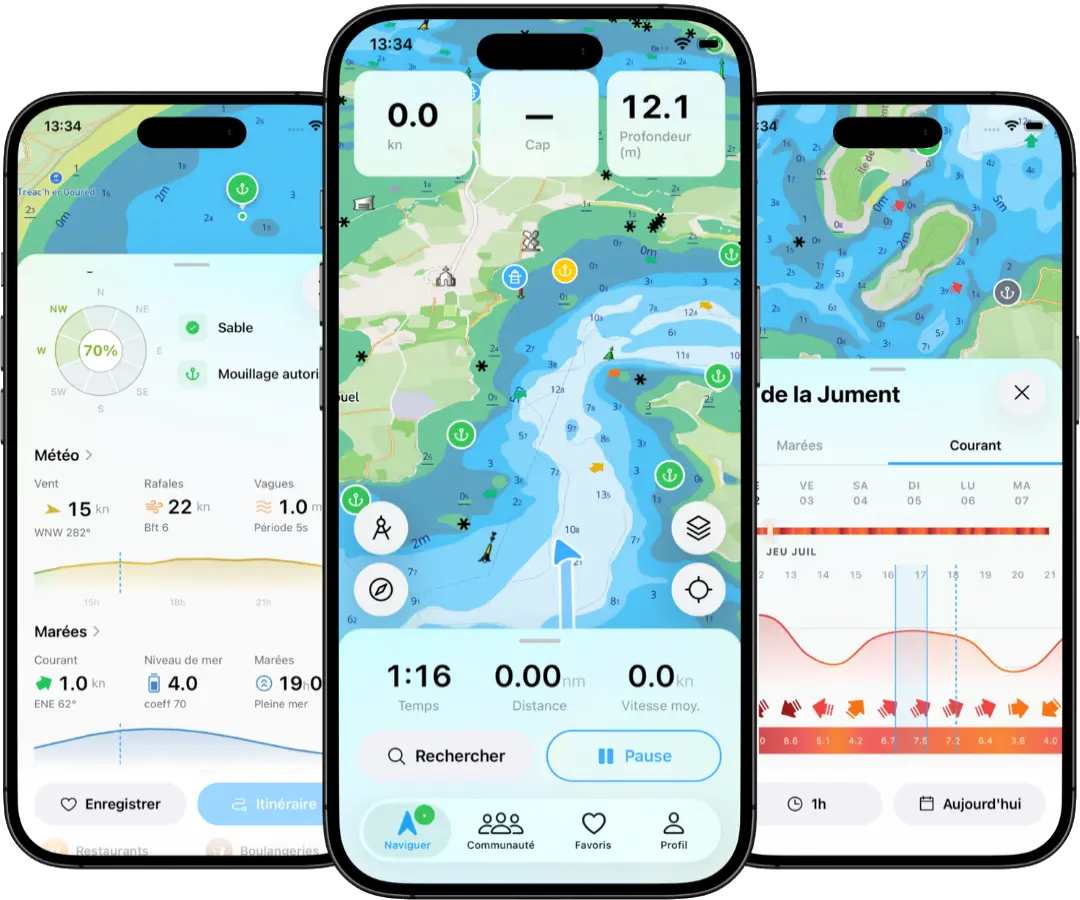
I will admit I almost skipped Brest. Coming down from L'Aberwrac'h with the Chenal du Four still fresh in my logbook, the chart showed a great grey naval port behind a narrow gate, and I half expected concrete and warships. Two days later I was reluctant to leave. The Rade de Brest is one of the biggest natural harbours in Europe, a sheltered inland sea you can cruise for a week without seeing the same bay twice, and the city marina puts you a five minute walk from a chandler, a fish market and a tram.
This is the guide I would have wanted before I went in: how to read the entrance, where to berth, and what the rade actually offers once you are inside.
Getting in: the goulet
Everything about Brest funnels through the goulet, the narrow neck between the open Iroise sea and the rade itself. It is about 1.8 km wide and guarded by forts on both sides, with the Pointe du Petit Minou and Pointe du Portzic to the north and the Pointe des Espagnols rising 60 metres on the south side.
The number that matters is the stream. At each turn of the tide the ocean refills the rade through that gap, and the current there runs 4 to 5 knots at springs. That is not a tidal gate in the Raz de Sein sense, you can punch it under power in settled weather, but a wind-against-tide chop builds fast in the goulet and it is miserable to motor into a foul 4 knots with a westerly behind it. I timed my entry for the last of the flood and carried the tide right up to the marina.
If you are coming from the north you will already have run the Chenal du Four and the Raz de Sein passage, so the goulet will feel tame by comparison. If you are heading the other way it is your first taste of the western tidal gates, and a gentle one. Either way, read the stream before you commit.
The two marinas, and which to pick
Brest runs two marinas under one management, and the choice between them shapes your stay.
Marina du Chateau sits right under the castle in the city centre. It has around 700 berths, of which roughly 125 are kept for visitors, plus space along the Perouse breakwater for larger yachts. You step off the pontoon into the old town. For a short stop, a crew change or a night ashore, this is the one.
Marina du Moulin Blanc is the bigger sister, a couple of miles east in its own bay, with the larger share of the more than 2,000 pontoon berths the two ports hold between them. It has the boatyard, the serious chandlery, the 24/7 fuel berth and the Oceanopolis aquarium next door, but it is a tram ride from town. If you need work done, or you want a quiet base to explore the rade, Moulin Blanc earns its keep.
Both marinas keep visitor berths accessible at all states of tide, which after the drying harbours of north Brittany feels like a luxury. Around 260 visitor berths exist across the two sites in summer.
Calling ahead and arriving
Report your arrival on VHF channel 9 for either marina. One quirk worth knowing: Brest does not take reservations for the visitor pontoon. The advice from the harbour office is to call the day before to ask about availability, then take your chances on the day. In July and August the Chateau pontoon fills, so an early afternoon arrival beats a 1900 one.
The fuel station at Moulin Blanc is self-service and runs 24 hours. Both marinas have water and electricity on the pontoons, free wifi and a black-water pump-out. Electricity in 2025 was being charged close to cost, somewhere around 0.15 to 0.17 euros per kWh, so a long stay with the heater on is no longer the free ride it once was.
What the rade actually gives you
Here is the part the pilot books undersell. Once you are through the goulet you have a sheltered cruising ground of roughly 180 square kilometres, ringed by coves, rivers and old forts, almost all of it open at any tide. After a fortnight of timing everything to high water on the north coast, the freedom is intoxicating.
A few of my favourites, going clockwise:
- The Pointe des Espagnols and Roscanvel, tucked under the Crozon peninsula, give shelter from anything in the western quadrant and a short walk to clifftop batteries.
- The Aulne, the river that drains into the south-east corner of the rade, carries you miles upstream past Landevennec abbey on a rising tide. It is the kind of pilotage that makes you forget the open sea exists.
- Bertheaume and the bays near the goulet are handy lunch stops with a fast escape to seaward.
I anchored two nights and used the marina for two, which felt about right. If you only have a single day inside, take the Aulne on the morning flood and come back on the ebb.
Weather and when to go
Brest sits at the western tip of Brittany, full in the path of the Atlantic depressions, and the weather here is more changeable than anywhere further south. The prevailing summer wind is west to northwest, force 3 to 5 on a normal day, but fronts roll through fast and the rade is exactly where you want to be when one does. I have sat out two days of a near-gale at anchor under the Crozon shore in complete comfort while the Iroise outside was unworkable.
The cruising season runs roughly May to September. July and August bring the warmest water and the most crowded visitor pontoons; June and September give you space and, often, the more settled high-pressure spells. The big advantage of Brest over the open coast is that the weather rarely traps you in port: even when you cannot get out through the goulet, you have a whole inland sea to play in. That is a luxury the drying harbours of the north coast cannot offer.
One practical point on forecasts. The local CROSS station, Corsen, broadcasts coastal weather and runs the safety watch for this stretch, monitoring VHF 16 and the working channels. Keeping an ear on the bulletins is worth it; the Iroise can change character within a tide.
A base, not just a stopover
The thing that surprised me most was how good Brest is as a launch pad. Ouessant and Molene lie just outside the goulet to the west, an easy day sail when the Fromveur stream cooperates. The Crozon peninsula and Camaret are a short hop south. And if you are working your way down the coast, Brest is the natural hinge between the rock-strewn north Brittany cruising guide waters you have just left and the gentler rias of the south Brittany cruising guide ahead.
It is also a proper city, which after weeks of villages is its own kind of relief. The covered market, Les Halles Saint-Louis, runs most mornings. The tram, opened in 2012, makes the supermarkets and the station painless. And the Brest maritime festival, the huge tall-ships gathering held every four years, turns the whole rade into a spectacle worth planning a cruise around.
Practical notes before you go
A short checklist from my own stop:
- Time the goulet for fair tide; the stream runs to 5 knots and wind-against-tide builds quickly.
- Call channel 9 the day before to gauge visitor space, then arrive early afternoon.
- Pick Chateau for the city, Moulin Blanc for the yard, fuel and a quiet rade base.
- Keep a chart of the rade handy; the cruising inside is the real prize, not the marina.
- Fuel is self-service 24/7 at Moulin Blanc; top up there before heading west to the islands.
I came to Brest expecting a grey naval town to refuel and leave. I left having found one of the best-sheltered, least-crowded cruising grounds on the whole French Atlantic coast, with a city attached. Do not make my mistake and treat it as a fuel stop. Give the rade three days and let the goulet do the rest.