Somewhere off the Ile de Re a pod of common dolphins picked up our bow wave and stayed with us for the best part of an hour. The kids hung over the pulpit, the autopilot held a steady course, and we did precisely nothing except keep doing what we were already doing. That is the secret nobody tells you about wildlife at sea: the best encounters are the ones where you change nothing and let the animals decide. The temptation to chase, to turn towards, to gun the throttle for a closer look, is exactly the thing that ruins it, and on the French coast it is increasingly the thing that breaks the law.
The distance rule you need to know
France has put a number on this. Since an order of 3 July 2021, it is prohibited to intentionally approach a marine mammal within 100 metres in French Mediterranean waters, and the same protective thinking governs conduct across French waters and the wider Pelagos Sanctuary, the 87,500 square kilometre cetacean reserve shared between France, Italy and Monaco.
The principle is the one to carry with you whatever coast you are on:
- Keep at least 100 metres from dolphins and whales. Do not drive towards them.
- If you are already inside that distance, reduce speed and hold a steady, predictable course.
- Slow right down, under about 5 knots, within 300 metres of animals at the surface.
- Never separate individuals from the group, and never get between a mother and a calf.
- If they come to you, leave the engine in neutral or hold your course and let them play. If they leave, let them go.
- Keep any encounter short, well under half an hour, so you are not the tenth boat to interrupt the same pod's feeding that day.
The Atlantic coast is not inside the Pelagos Sanctuary, but the Bay of Biscay is some of the richest cetacean water in Europe, and the same standard of conduct applies. The respect you owe a feeding pod off Belle-Ile is no less than the one you owe it off Cap Ferrat.
What lives out here
The Atlantic seaboard from the Vendee down to the Basque coast is busy with life. Common and bottlenose dolphins are the headline, often in large pods, and the deeper water of Biscay holds fin whales, minke and the occasional pilot whale. The food chain that supports them, the tuna and the baitfish boiling under the gulls, is a spectacle in its own right, and I write about how it all hangs together in my notes on the Bay of Biscay food chain.
Closer in there are seals on the rocky islands and a seabird coast that rewards a slow approach. The gannet colony on the Sept-Iles off north Brittany is one of the great sights of the French coast, and the same keep-your-distance logic protects nesting birds as protects whales, a theme I follow in my piece on marine reserves in France by boat.
Reading behaviour, not just distance
A number on a chart is a floor, not a target. The better skill is reading what the animals are telling you. Dolphins that swing in deliberately to surf your bow are choosing the encounter, and as long as you hold course they are in control of it. Dolphins moving away, or repeatedly diving and changing direction, want nothing to do with you, and chasing them is both pointless and harmful.
Feeding animals deserve the widest berth of all. A pod working a bait ball is doing the serious business of staying alive, and a boat that ploughs in to get a photograph can scatter the fish and waste the whole effort. Resting animals at the surface, logging in the sun, are equally vulnerable. The honest rule is that if your presence is changing what the animal is doing, you are too close, regardless of what the tape measure says.
Wash, noise and the things you forget
Distance is only part of it. A boat is a noise machine, and underwater that noise travels far. Cutting your revs near wildlife is not only about speed, it is about the racket you broadcast. Slow down smoothly, avoid sudden gear changes, and resist the urge to circle for a second pass.
Wake matters too, especially near hauled-out seals and low rocky islands where a sudden wash can sweep birds off a nesting ledge or panic a colony into the water. The discipline of reading where your wake lands and easing off in sensitive water is one I treat as part of basic seamanship, and it ties directly into the habits I describe for low-impact anchoring for wildlife. The quieter and gentler your boat, the more you will actually see, because animals that do not feel hunted stay around.
Snorkelling, fishing and the in-water encounters
Wildlife-friendly cruising does not stop when you anchor. The temptation to swim towards a curious seal or to feed fish off the swim ladder is strong and best resisted. Feeding wild animals teaches them to associate boats with food, which ends badly for them. If a seal investigates your snorkelling, enjoy it and let it set the terms. If you fish, take only what you will eat, respect the size and bag limits that apply to recreational fishing in France, and do not leave discarded line or hooks in the water where they foul birds and turtles.
Night anchoring and the things you cannot see
Wildlife does not clock off at sunset, and the boat keeps affecting it after dark. Bright deck and underwater lights left blazing all night disorient fish and attract them in ways that disrupt natural feeding, and on low islands they can confuse nesting seabirds. A boat that runs a soft anchor light and an interior glow, rather than floodlighting the whole bay, sits more gently in the dark. The bioluminescence that lights up some French anchorages on warm still nights is a reminder of how much life is in the water you are floating on, most of it invisible until you disturb it.
Anchoring choice matters here too. Dropping the hook on a clean sandy bottom rather than a living bed protects the very habitat that feeds the wildlife you came to watch, which is why I treat seabed-friendly anchoring and wildlife-friendly cruising as two halves of the same habit.
Knowing when you are in a protected area
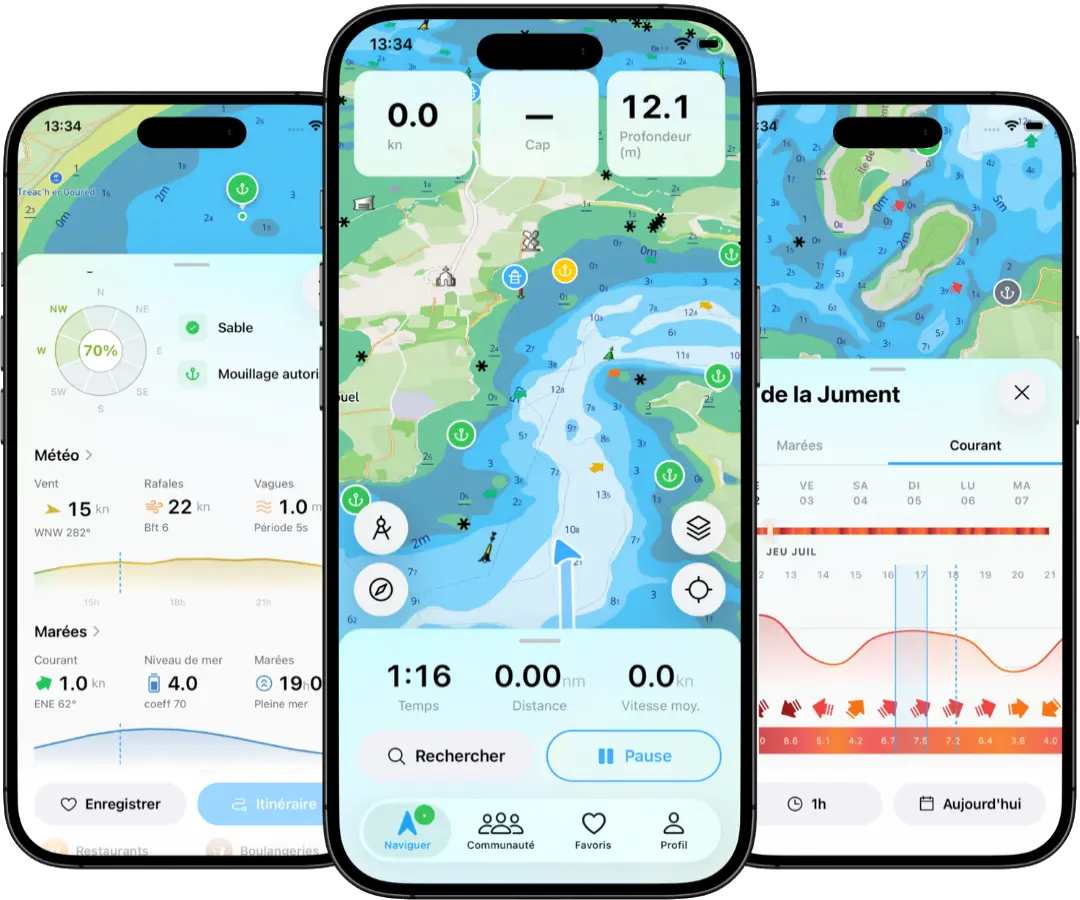
The French coast is dotted with marine protected areas, reserves and national park zones where the rules go beyond the general 100 metre standard. Speed limits, no-anchoring zones, restricted approaches to bird colonies and seasonal closures all apply in specific places, and they are not always obvious from the deck. Before you cruise a new stretch, check whether you are entering a reserve, because ignorance is no defence and the fines for disturbing protected species are real. A quick look at the chart and the local notices, plus the cruising apps that flag reserve boundaries, saves you from blundering into a closed zone with the engine running.
The reward for getting this right is access. Reserves protect the richest wildlife precisely because they are managed, and a visitor who plays by the rules is welcome in some genuinely extraordinary water.
Why the restraint pays off
Here is the thing I did not expect when I started cruising more carefully. Keeping my distance has given me better wildlife encounters, not worse ones. The animals that approach a calm, predictable boat stay longer and come closer than anything I ever achieved by chasing. That hour off the Ile de Re happened because we left the dolphins alone, and they chose us.
There is a longer game too. Every pod that learns boats are harmless, every colony that is not flushed off its rocks by a careless wake, is a creature still there next season for the boat behind you. Cruising the French Atlantic well means treating the wildlife as the residents and yourself as the visitor passing through their water. Keep your distance, kill the noise, watch the wake, and the coast will show you far more than any chase ever could.